Bensalem Quality Roofing provides roof inspection in Bensalem, PA and serves surrounding cities including Lower Southampton, Delran, Upper Southampton, Bristol Township and Cinnaminson. We have been on roofs across this area for 20+ years, and an inspection from us means walking the slopes, looking closely at the flashing, and going into the attic to see what the shingles cannot show.
People call for an inspection for very different reasons: a stain on the ceiling, an offer on a house, a rental that has to pass the township’s checklist, a storm that took a few shingles, or simply a roof nobody has looked at in years. The inspection is the same careful process in every case. What changes is what the report has to answer.
You get photos of what we found and a written summary that separates what needs attention now from what can wait. If the roof can be repaired, we say so before the word replacement comes up, and if it cannot, the photos show why.
What a Residential Roof Inspection Covers
Shingles, Slopes and Roof Surfaces
We walk each slope looking for lifted, creased, cracked or missing shingles, bare spots where granules have washed off, and soft areas that point to wet decking. Exposed nail heads, old patches and areas sealed with roof cement tell us where earlier repairs were made. Each one gets photographed in place so you can see it.
We also note the shingle type and whether the roof carries one layer or two. The residential code allows no more than two layers, so a two-layer roof changes the cost and scope of any future work. That one fact often decides whether a later replacement is a simple overlay question or a full tear-off.
Attic Decking, Ventilation and Insulation
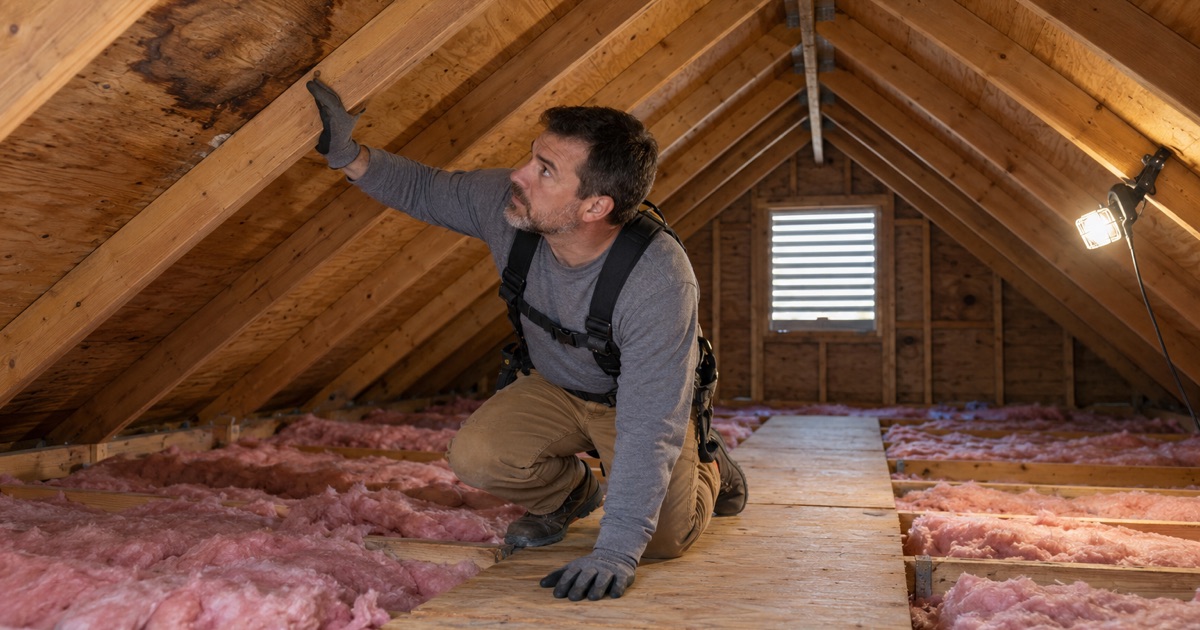
The attic is where many roof problems first show themselves. Dark stains on the underside of the deck, rusted nail tips, frost in cold weather and daylight at the eaves each point to a specific cause. We look at the soffit intake and ridge exhaust and judge whether the attic can actually breathe.
Poor ventilation cooks shingles from below in summer and condenses moisture on the deck in winter. Bathroom fans and dryer vents that empty into the attic instead of outdoors are a common finding and an easy fix. Catching them during an inspection prevents a mold or decking problem that would otherwise be blamed on the roof.
Flashing, Chimneys, Skylights and Gutters
Flashing at the chimney, at dormer walls, around skylights and at every pipe boot is where most leaks begin. We check whether step and counter flashing is intact, whether the chimney has a cricket where it needs one, and whether skylight curbs are sealed. Cracked rubber pipe boots are noted even if they are not leaking yet.
Gutters are part of the roof system, so we check their pitch, the drip edge above them and whether water is reaching the downspouts. Water running behind a gutter rots the fascia and wets the wall. The report says whether the gutters can stay with the next roof or should be replaced with it.
Inspections Tied to a Sale, a Rental or a Claim
Before Listing a House or Making an Offer
A seller who knows the roof’s condition before listing can repair on their own schedule rather than under a buyer’s deadline. Buyers use our report to understand what a home inspector flagged and what it would cost to address. Bensalem’s resale use and occupancy permit, filed a month before settlement, asks for chimney, electrical and heating certificates but names no roof item, so the roof question is settled between buyer and seller.
We write the report so it can be handed to the other side of the sale. It lists the roof’s age as best it can be judged, the number of layers, the condition of each slope and the repairs we would recommend. Clear facts make a negotiation shorter.
Bensalem Rental Checklist and Landlord Inspections
Bensalem’s residential rental use and occupancy inspection checklist includes a roof item, which reads ‘Roof – No obvious defects.’ A non-owner-occupied dwelling carries a $50 annual rental license and a $100 inspection fee per unit for buildings of one to three units. Landlords who have us look at the roof before the township inspection can fix a loose shingle or open flashing ahead of time.
Other towns in the area have their own rental and resale checklists, and some name gutters and downspouts as well as the roof. We check the list for the property’s own municipality and inspect against it. A failed item can delay a new tenant’s move-in date.
Storm Damage Documentation for Insurance
After high winds or hail, an inspection gives you dated photos and a written description of what the storm did to the roof. That record is what your own claim is built on. When you ask, we will meet the adjuster on site and walk the roof with them.
We stop at documentation and do not negotiate the claim, since in Pennsylvania that role belongs to you, your attorney or a licensed public adjuster. What we can do is make sure the damage is visible and clearly described. A good record keeps storm damage from being mistaken for age.
Commercial Roof Inspections
Membrane Seams, Drains and Ponding
On a low-slope commercial roof we check every seam on EPDM, TPO or modified bitumen, the condition of the surface and any areas where water is ponding. Drains, scuppers and gutters are checked for blockage and for the condition of the flashing around them. Standing water days after rain shortens a membrane’s life.
We probe for wet insulation where the surface is soft and photograph every opening, blister and split seam. The goal is to find small problems while they are still small. A torn seam caught in the fall is a patch, and one found after a winter is often a wet roof.
Rooftop Units, Curbs and Parapet Walls
Rooftop heating and cooling units sit on curbs that need their own flashing, and service technicians walking to them wear paths in the membrane. Parapet walls need intact caps and counter flashing to keep water out of the wall. We inspect all of it and note where foot traffic pads would protect the roof.
Written Condition Reports for Owners and Managers
The report for a commercial roof is written for the person who has to make a budget decision. It describes the condition of each area, separates urgent repairs from maintenance, and gives a realistic view of remaining life. Owners use it to plan, and property managers use it to answer tenants.
Our Step-by-Step Roof Inspection Process
Step 1: Ground Walk and Gutter Check
We start by walking around the house to see the roof’s shape, the gutters and downspouts, and any obvious damage. From the ground we can often spot sagging lines, missing shingles and debris in the gutters. This tells us where to look most closely once we are on the slope.
Step 2: On the Roof
With fall protection where the pitch calls for it, we walk the slopes and inspect the shingles, flashing, penetrations, valleys and ridge. Every finding is photographed where it sits. If a slope is too steep or fragile to walk safely, we say which areas we viewed from a ladder.
Step 3: In the Attic
Inside the attic we check the deck, the ventilation and the insulation and look for stains or frost. Many questions raised on the roof are answered here. A water track in the attic shows exactly where a leak enters.
Step 4: Photos and a Written Report
You receive the photos and a written summary of what needs attention now, what can wait and how much life the roof has left. If repairs are recommended, they are listed as separate items with prices. You decide what to do next, with no pressure to replace a roof that can still be repaired.
- 20+ Years Experience
- Attic Checked on Every Leak
- Itemized Written Scopes