Bensalem Quality Roofing brings 20+ years of work to roofing in Plymouth Township, and on a townhouse row the first question is seldom which shingle to use. It is who holds the roof: the owner, the homeowners association, or a split written into the community’s documents. That answer decides who signs the contract, who pays for it, and who has to approve the color before a single bundle arrives.
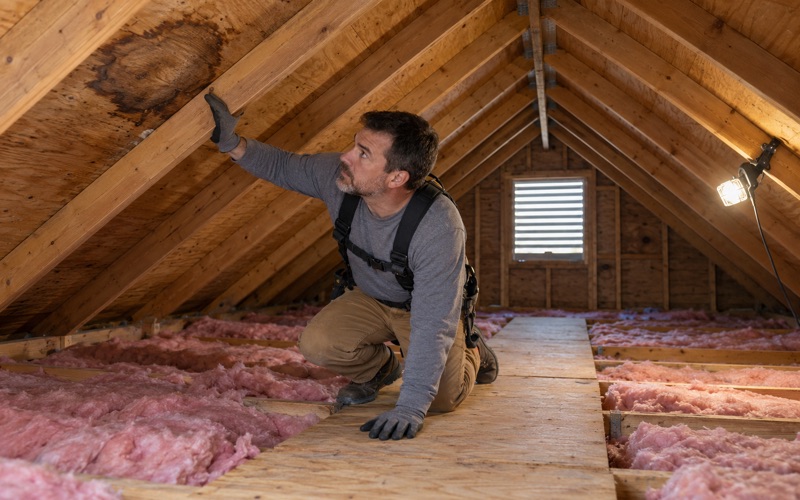
Before replacement comes up at all, we give a straight answer on whether the roof can be repaired. A leak call includes a look in the attic as well as on the roof, so we trace the water to where it actually enters rather than pricing a guess. On an attached home, that can mean checking the framing near the party wall, where a neighbor’s flashing sometimes sends water across the line.
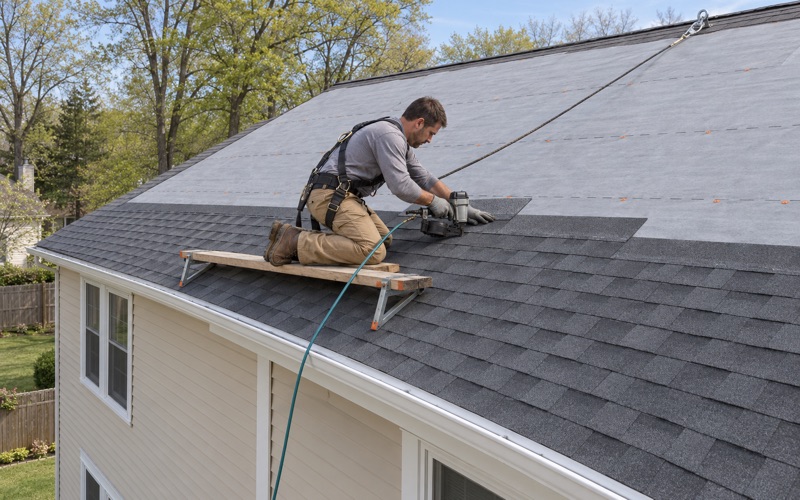
When a replacement is the right call, our written scope breaks the job into separate lines for tear-off, decking, underlayment, flashing, ventilation and gutters. That matters on townhouses, because an owner and a board may each be collecting bids and need to compare them item by item. It also makes it plain which lines touch a common element and which stay on the owner’s side.
Two Townhouse Communities, Two Ways of Listing the Fee
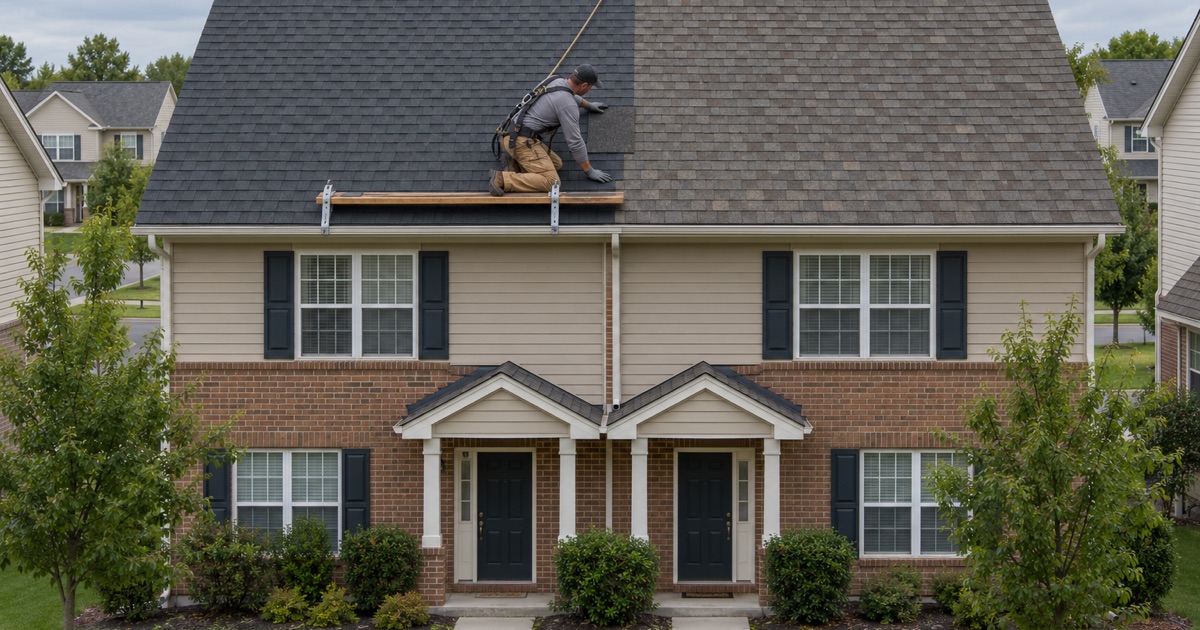
Plymouth Township counts 1,145 one-unit attached homes in the latest five-year Census estimates, and 1,042 of them are owner-occupied, about 91.0%. For most townhouse owners here, then, the roof question is a household decision rather than a landlord’s. Two communities built around the turn of the century show how differently that question can be framed on paper.
Oakwood at Plymouth on Ashley Way
Off Ashley Way in Plymouth Meeting, the townhouses that listings place in Oakwood at Plymouth date from 1999 and 2000. Their monthly association fee runs from $345 to $365 across recent listings, and those listings name exterior building maintenance among the items the fee includes. One listing for an Ashley Way home describes the association covering lawn care, snow removal, trash and exterior maintenance.
Exterior building maintenance is a broad phrase on a listing sheet. It can cover painting trim, cleaning gutters or patching siding, and it may or may not extend to replacing a roof at the end of its life. The listing tells a buyer what the fee is said to include; it does not quote the declaration, and the declaration is what an owner and a roofer both have to read.
Hill View on Rolling Hill Drive
A short distance away on Rolling Hill Drive, Hill View is a townhome subdivision that Nolen Builders put up around 2002, with listed build years of 2002 and 2003. Listings put its monthly fee between $270 and $292. One fee breakdown names common area maintenance, lawn maintenance, snow removal and trash, and carries no line for exterior building maintenance.
The absence of that line is easy to read as proof that each owner carries the roof, but a listing sheet is not a legal document. One Rolling Hill Drive listing notes a newer roof, which suggests at least one roof on the street has been redone, though not who paid for it. At least one home, 101 Rolling Hill Drive, lists stucco construction over two levels, which shapes how wall flashing meets the roof edge.
Why a Fee Line Does Not Settle the Roof
Both communities were built within a few years of each other, so their roofs are now roughly 23 to 27 years old. That age is a reason to ask the question now, not the answer to it. The answer sits in each community’s declaration, and we did not read either one, so nothing on this page says which party replaces a roof on Ashley Way or Rolling Hill Drive.
What the two fee lists do show is that neighboring communities from the same era describe their coverage differently. An owner who moves from one to the other, or who compares notes with a friend in the other community, can easily assume the wrong arrangement. We ask to see the governing documents before pricing, because the paperwork shapes the contract as much as the roof does.
Looking for roofing closer to Westampton? See Roofing in Westampton.
What Pennsylvania’s Planned Community Law Says
Common Elements and Units
Pennsylvania’s Uniform Planned Community Act sets a default split. Section 5307(a) says that, except to the extent the declaration provides otherwise, the association is responsible for maintenance, repair and replacement of the common elements, and each unit owner is responsible for maintenance, repair and replacement of the unit. A separate subsection and the act’s insurance section can also move that line.
For a townhouse, the open question is whether the roof belongs to the unit or to the common elements. In some communities the unit boundary runs to the outside of the shell, roof included; in others the exterior is carved out as a common or limited common element. The statute does not decide that for any particular community; the declaration and its plats do.
The Words “Except to the Extent Provided by the Declaration”
That opening clause is why we never assume. A declaration can assign roof replacement to the association even when the roof sits inside the unit, or leave it to owners while the association handles routine exterior care. It can also require the association’s approval of materials and colors before any owner replaces a roof, whoever pays.
For a Plymouth Township owner, the practical result is that the statute frames the question and the declaration answers it. When an owner hands us that document, we read the maintenance and architectural sections with them before writing the scope. If the wording is unclear, the association’s manager or attorney is the right person to interpret it, not the roofer.
Planned Community or Condominium
Not every attached community in Pennsylvania is a planned community. Some are organized as condominiums, which fall under the Uniform Condominium Act instead, with its own rules on units and common elements. We have not checked how either Oakwood at Plymouth or Hill View is organized, and the governing documents are where an owner confirms which act applies to the home.
Reading the Declaration and Resale Certificate Before a Replacement
Where the Roof Shows Up in the Declaration
Roof responsibility rarely sits under a heading called roofs. It usually turns up in the definitions of unit and common elements, in a maintenance schedule, or in an architectural control section listing what owners may change. We look for all three, plus any clause on reserves, because a community that plans to replace roofs together usually says so in more than one place.
Many owners keep only the closing packet, not the full recorded declaration. The association or its management company can usually provide a copy, along with any rules and amendments adopted since. An amendment matters as much as the original document, since boards sometimes revisit exterior responsibilities as the first generation of roofs nears replacement.
What a Resale Certificate Has to Disclose
A resale certificate in a planned community must state, under section 5407(a), any capital expenditures the association proposes for the current fiscal year and the two that follow. It must also state the amount of any reserves held for capital expenditures. For roofs of this age, those two lines are the best early signal of what the association expects to spend.
If a certificate lists roof replacement among proposed capital work, the association is planning for it in some form. If it shows modest reserves and no roofing line, an owner should ask directly before assuming the association will pay. Buyers on Ashley Way and Rolling Hill Drive alike can use the certificate to raise that question before closing rather than after the first leak.
Questions to Bring to the Board
Before we write a contract for an attached home, we suggest the owner put three questions to the board in writing: who replaces the roof and who pays, whether approved shingle lines and colors are on file, and whether the association plans to do the whole row together. Written answers keep the owner, the board and the roofer working from the same facts.
If the association is the one replacing roofs, we can price the work for the board with the same itemized scope we give an owner. If the owner is responsible, the contract follows Pennsylvania’s home improvement law, with the three-business-day cancellation notice and a deposit kept within the legal limit. Either way, the paying party is named on the paperwork from the first estimate.
Replacing One Townhouse Roof in a Row of Matching Roofs
The Shared Wall and the Neighbor’s Side
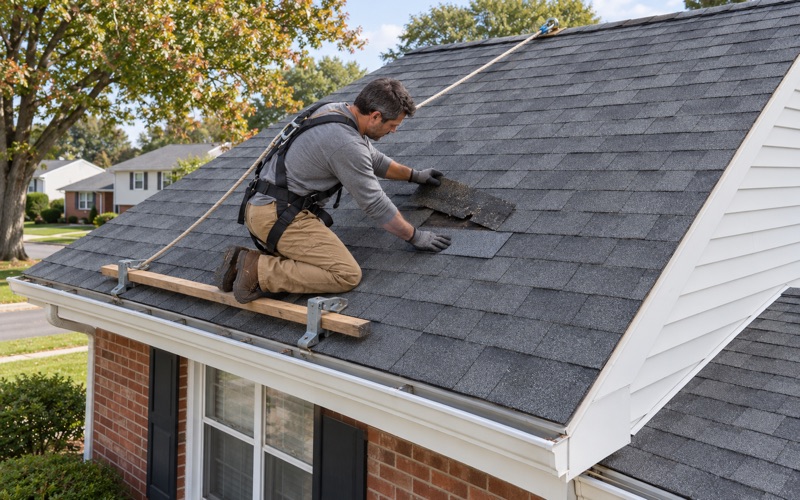
Where owners replace their own roofs, a row rarely turns over all at once, and the first owner to go is tying new material into an older roof next door. We plan the job with the party wall and the neighbor’s roof in mind: how the new underlayment laps at the line, where the ridge ends, and how water running off one roof is handled by the next.
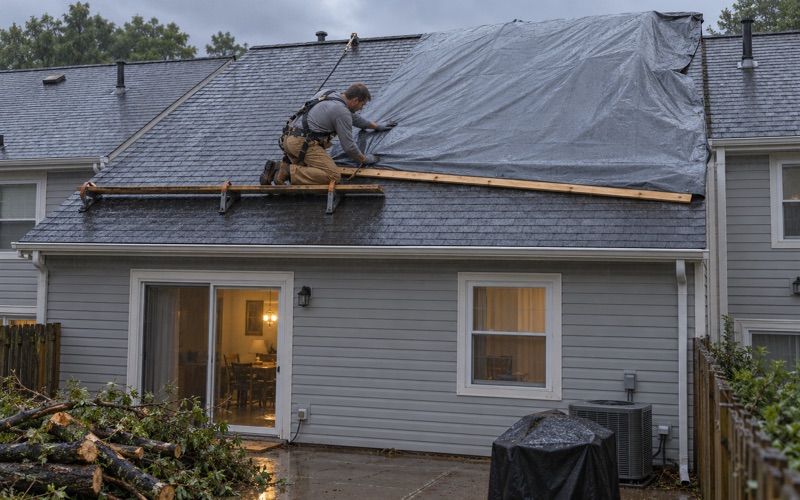
We talk to the neighbor before the tear-off when the owner agrees, because the crew will be working within feet of the shared line and debris can land on both sides. A tarp across the neighbor’s edge and a clear plan for the transition protect both homes. It also heads off the dispute that starts when a new seam fails onto someone else’s ceiling.
Matching Materials and Flashing
Matching is about more than color. An architectural shingle such as GAF Timberline HDZ, Owens Corning Duration or CertainTeed Landmark has its own profile and exposure, and a mismatch shows at the party line for the rest of the roof’s life. If the declaration or the board names a product, we quote that product; if it does not, we bring samples for approval before ordering.
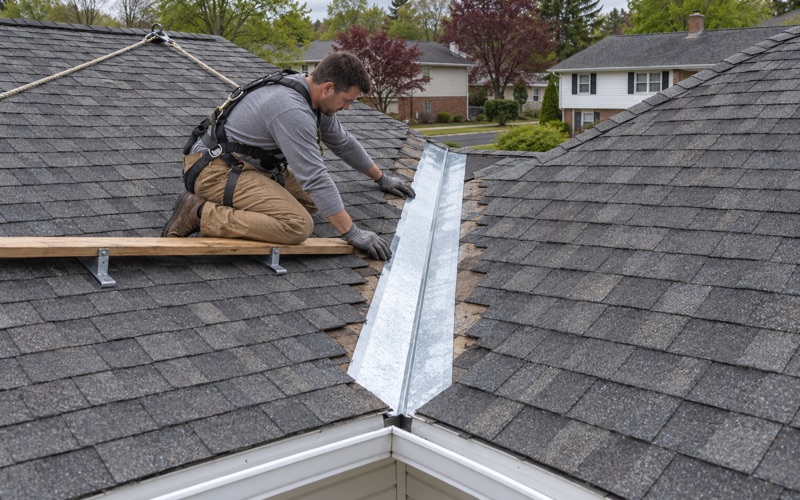
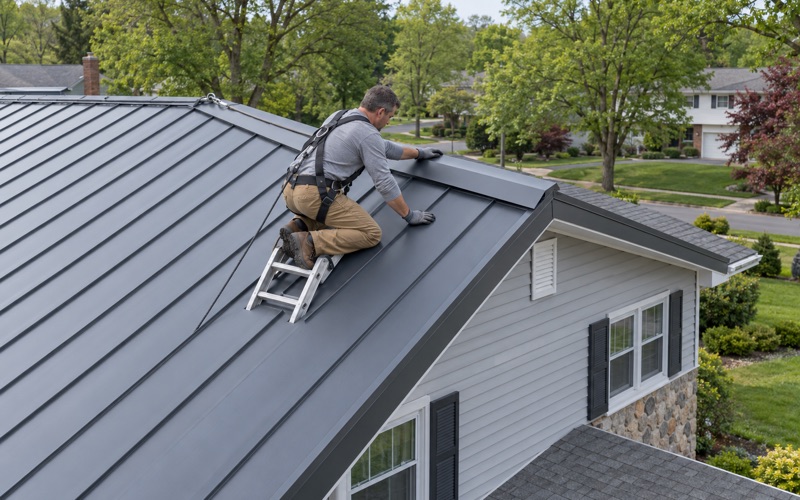
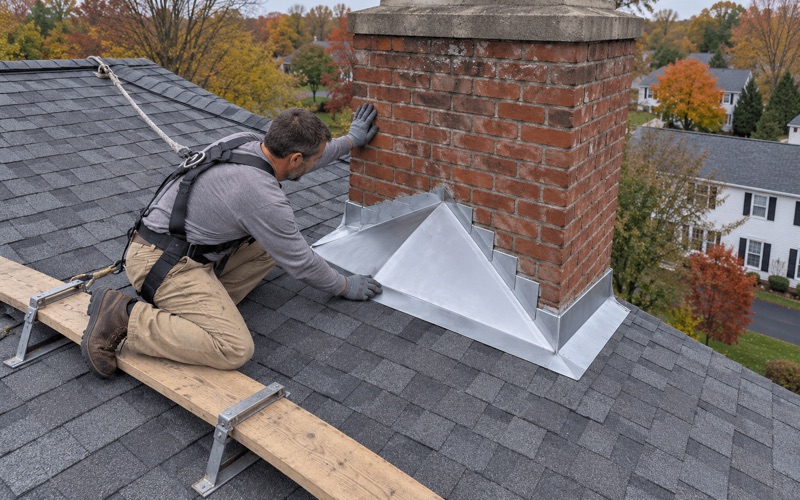
Step, counter and chimney flashing is replaced with the roof rather than reused under new material. On a townhouse that includes the flashing where the roof meets a taller neighbor’s wall, and on stucco exteriors the counter flashing has to be set so the wall finish sheds water over it. Damaged decking found after tear-off is photographed and shown to the owner before replacement, at a per-sheet price set in the contract.
Permits, Code Enforcement and the End of the Day
Plymouth Township is a home rule municipality, and its own Residential Code Package sets the permit rule here. It lists replacement of existing roof material up to 25% of the total roof area within any 12-month period as ordinary repair needing no permit, and says any work not listed requires the appropriate permit from Plymouth Township. We check a full townhouse replacement with Plymouth Township Code Enforcement on Belvoir Road before pricing it.
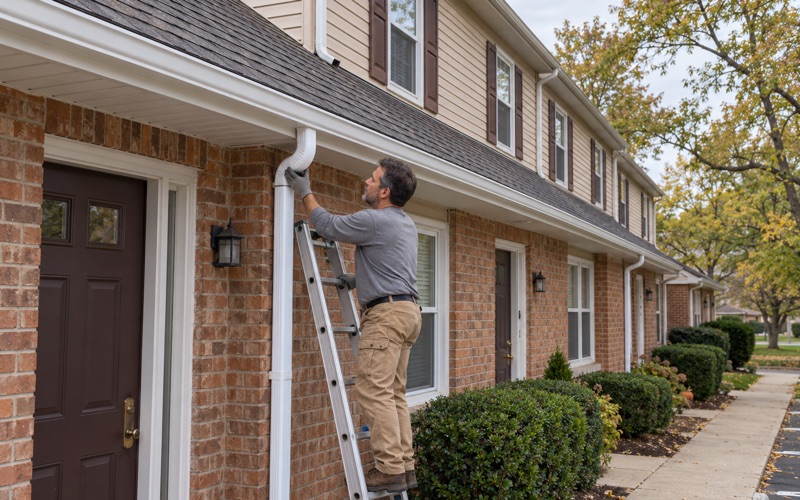
Gutters and downspouts are sized and pitched with the roof, which matters on a row where one home’s downspout empties near another’s walk. At the end of each work day we clean the driveway, yard and gutters, including a magnet sweep for roofing nails along the shared walks. Neighbors in a tight row notice a stray nail long before they notice the new shingles.
- 20+ Years Experience
- Attic Checked on Every Leak
- Itemized Written Scopes