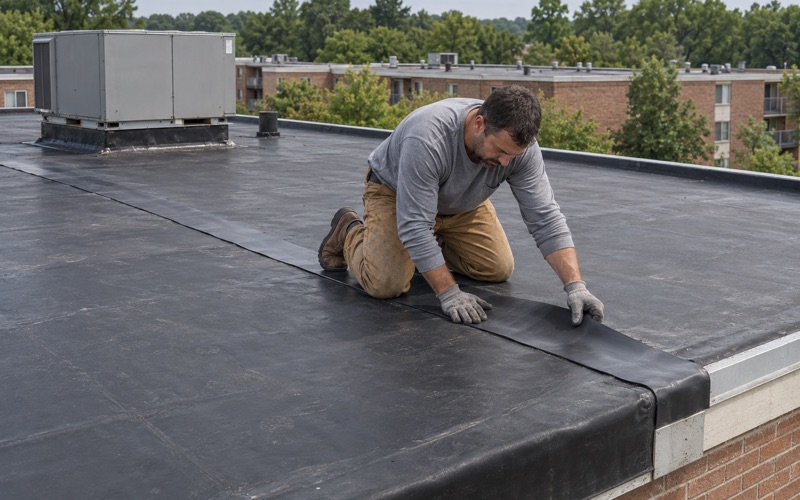
Bensalem Quality Roofing has spent more than 20 years on roofing in Palmyra and across the river, and the work we do here starts from one habit: find the cause before anyone talks price. A leak call gets a look in the attic as well as on the shingles, because water rarely shows up inside directly under the spot where it got in.
The second habit is honesty about scope. Before replacement is ever on the table, we tell you plainly whether the roof in front of us can be repaired, and if it can, that is the job we quote. When a new roof is the right answer, the written scope breaks tear-off, decking, underlayment, flashing, ventilation and gutters into separate lines you can hold against any other estimate.
This page is about one kind of damage in particular: wind that pushes hard from a single direction for a few minutes and then is gone. The borough has a surveyed example of exactly that, and it changes where we look first on a roof after a storm, what we photograph, and how we write it up for an owner who plans to file a claim.
April 1, 2023: the downburst that began in Palmyra
Where and when it started
The National Weather Service office in Mount Holly surveyed a downburst that began in the borough at 6:55 p.m. on April 1, 2023, near the intersection of East Broad Street and Elm Avenue. It ran 1.0 mile east-southeast and ended over Cinnaminson by 6:58 p.m., with an estimated peak wind of 100 mph and a path up to 600 yards wide at its widest point.
The survey statement describes strong downburst winds across parts of Palmyra, Riverton and Cinnaminson, with numerous trees uprooted or snapped starting at that East Broad Street corner. Three minutes from start to finish is short, and that is part of what makes an event like this easy to underestimate when the yard looks mostly fine the next morning.
Downburst or tornado: what the trees told the survey
The deciding detail in the survey is a single line: all trees were found to have fallen in an east-southeasterly direction. A tornado rotates, so the debris it leaves tends to point in different directions across its path. Trees lying parallel, every one pushed the same way, are the signature of straight-line wind, and that is how the Weather Service classed what happened here.
That distinction matters for more than the record. The survey kept this downburst separate from the tornado that formed just afterward, and the damage it logged was to trees only. The 100 mph figure is an estimated peak, not a reading taken on every street. For a homeowner, the useful takeaway is the direction of the wind, not the headline number.
What the record does not say
We are careful with this event because it is easy to overstate. The survey records no house or roof damage in the borough, and we will not tell you a roof was hurt because of a date on a calendar. What we can say is that a surveyed wind of this kind is a good reason to have a roof looked at, and that the look should start in a particular place.
Looking for roofing closer to Yeadon? See Roofing Services in Yeadon.
Straight-line wind and the windward side of a roof
Why one-sided wind loads one side
Straight-line wind pushes from one direction instead of swirling, so the force lands hardest on the parts of a house that face into it. On a roof, that means the edges, rakes and ridge on the windward side take the first and heaviest load, while the opposite slope can look untouched. For a wind that laid trees down toward the east-southeast, the exposed side is the one facing back toward the west-northwest.
That last point is our own reading of the survey, not something the Weather Service measured on any roof. It is still the most practical way to aim an inspection. When we walk a roof after a one-direction wind, we start on the side that faced it and work across, rather than circling the whole roof with the same level of attention everywhere.
Edges and rakes go first
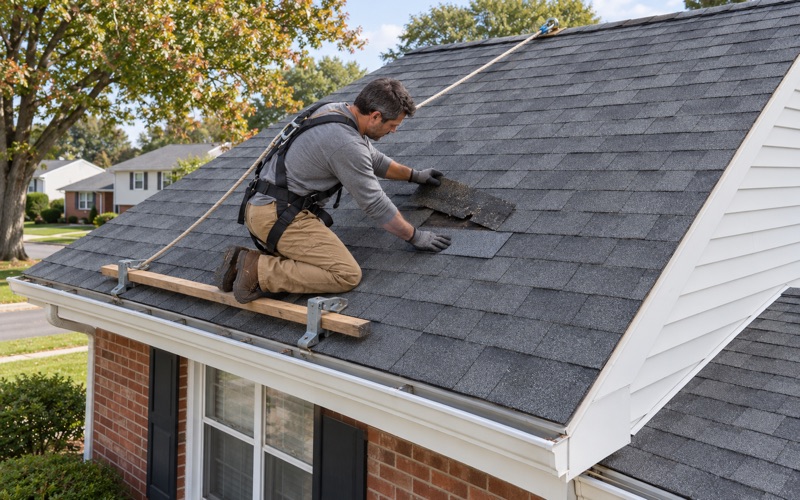
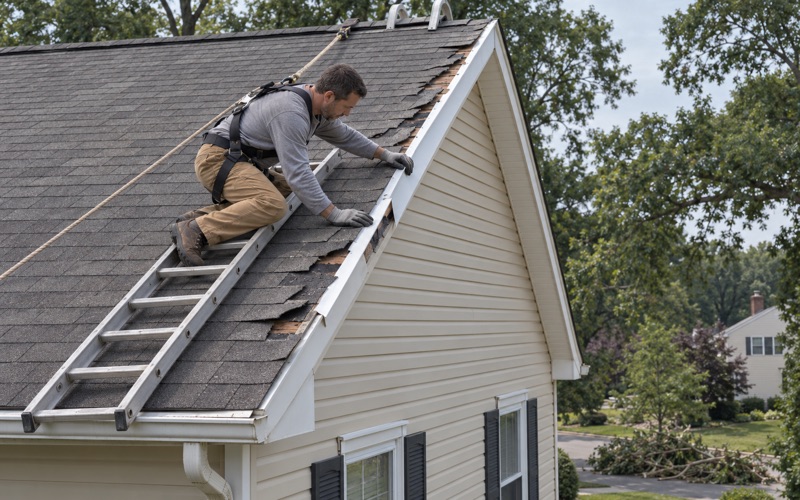
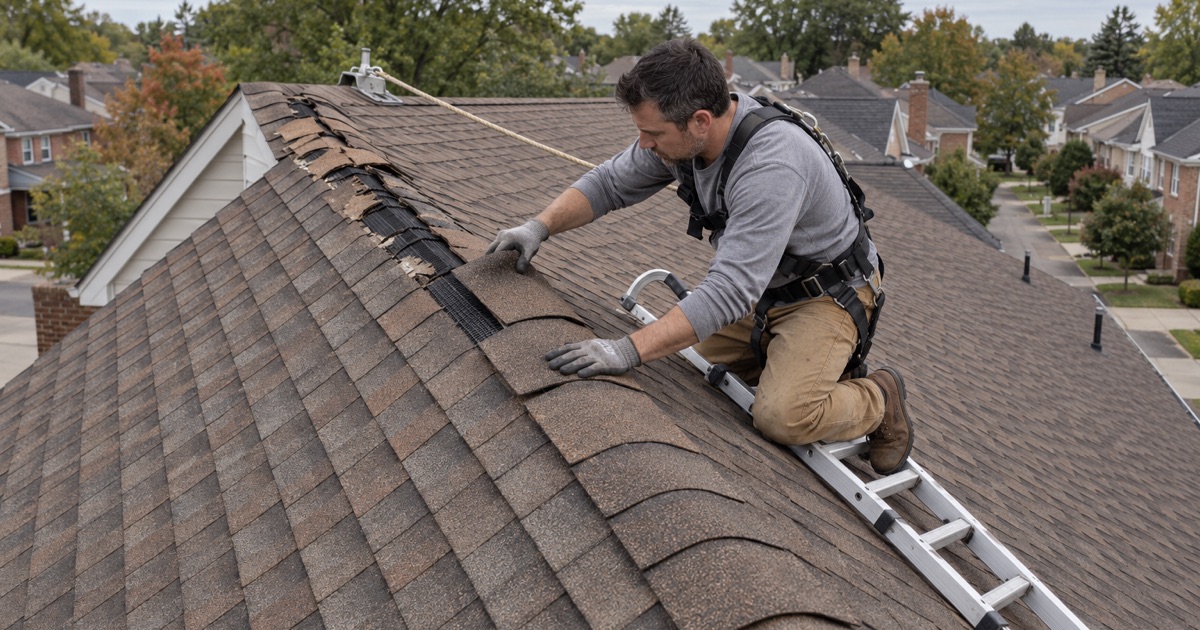
Wind lifts shingles at the perimeter, where it can get under the edge. We check the drip edge at the eaves and rakes, the starter course beneath the first row, and whether the shingles along the rake have been lifted and set back down with the seal broken. A broken seal often reads as fine from the ground and then fails in the next storm.
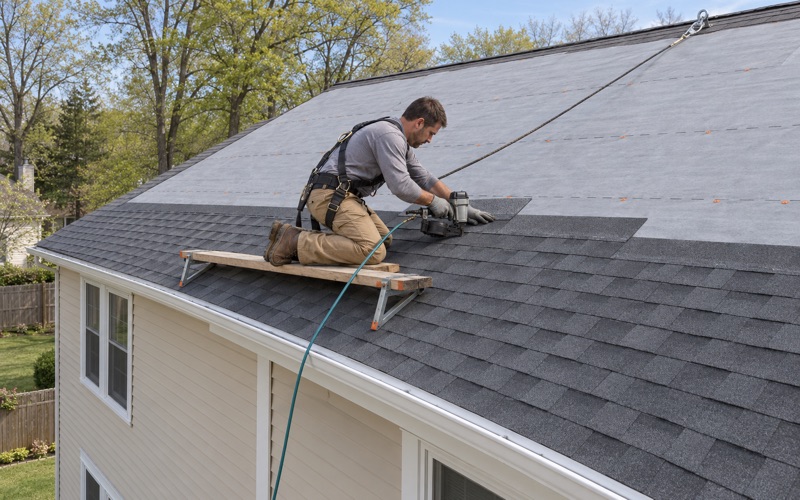
When a section has to be replaced, we match the shingle where we can and talk through wind ratings before choosing a product. Architectural shingles tested to ASTM D3161 Class F or ASTM D7158 Class H are rated for higher wind than basic three-tab, and that rating only holds when the edge is nailed and sealed to the maker’s pattern.
Ridge caps and ridge vents
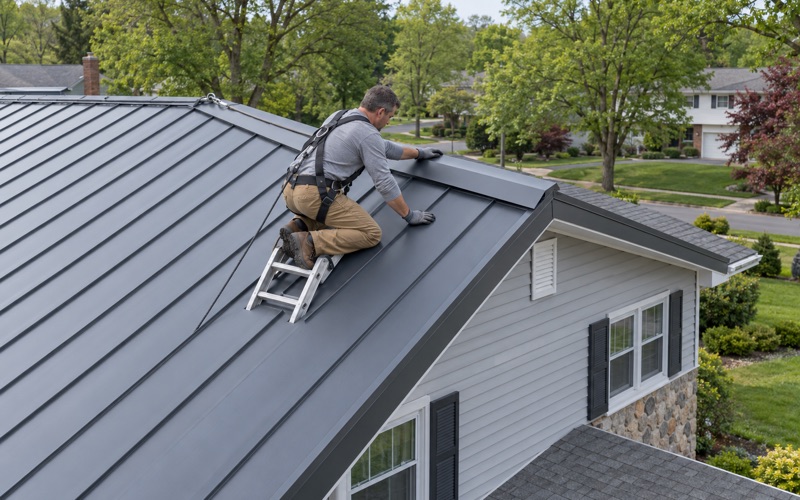
The ridge sits highest and sees wind on both slopes, but in a one-sided push the cap shingles on the windward side tend to peel first. We look for cracked or missing caps, exposed nail heads, and a ridge vent that has shifted or lifted at its ends. A vent that has moved can let wind-driven rain straight into the attic.
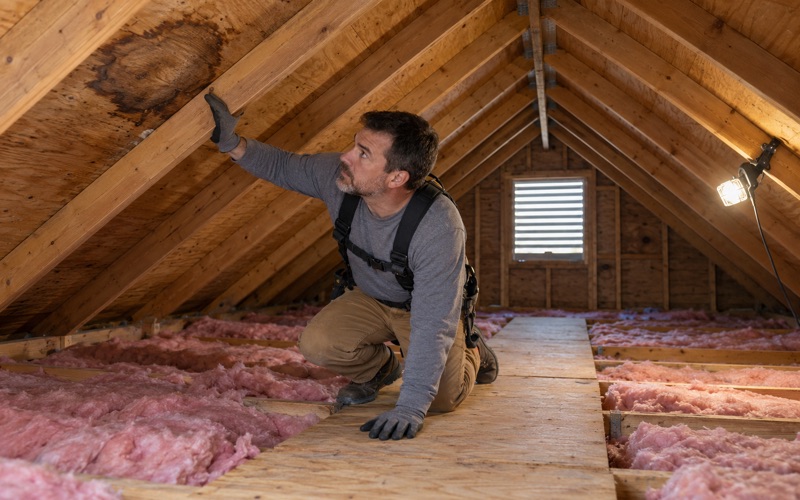
That is where the attic check earns its keep. From inside, we look at the sheathing under the ridge and along the windward eave for fresh staining, daylight at the nail lines, or damp insulation, because wind damage that has not yet leaked is far cheaper to fix than the ceiling it would eventually reach.
Fallen limbs, gutters and the roof after a wind event
When a limb comes down on the roof
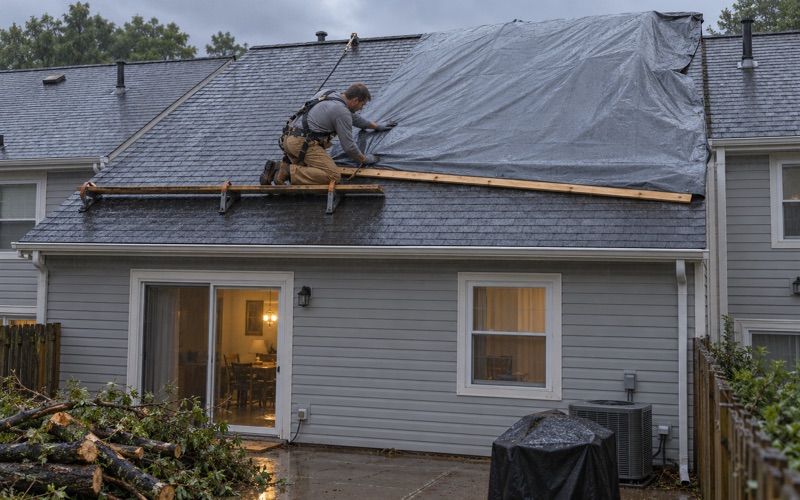
The survey’s own record is about trees, and trees are what usually turn a wind event into roof work. A limb that hits a roof can crack shingles, bruise the mat underneath without breaking the surface, or punch into the decking. If one is still lying on the roof, we leave the cutting to a tree crew and then assess what sits under the impact point.
Decking that turns out to be cracked or soft once the old roofing is off gets photographed and shown to you before it is replaced, at the per-sheet price already written into the contract. You see the board, you see the price, and nothing gets added to the bill as a surprise after the crew has left for the day.
Gutters take the side load too
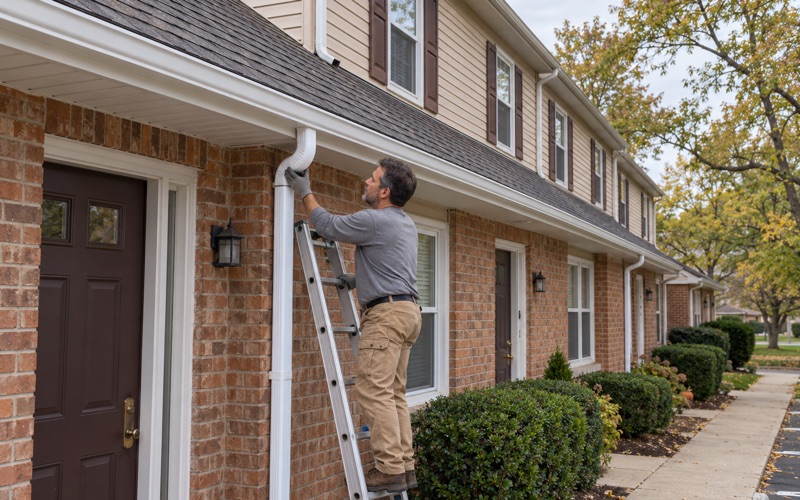
Wind and falling branches bend gutter runs, pull hangers loose, and knock downspouts out of their straps, usually on the same side of the house the wind hit. A gutter that sags afterward holds water against the fascia and drip edge. We size and pitch gutters and downspouts along with the roof, often in seamless aluminum, rather than treating them as an afterthought.
On older houses with painted trim and fascia, we work to the EPA RRP lead-safe rule, which applies to homes built before 1978. That covers a large share of the borough: according to the American Community Survey, 1,042 of its 3,388 housing units were built in 1939 or earlier, and many more date from the decades that followed.
Photographs and the claim
If you plan to file with your insurer, we photograph the damage and write it up for your own claim, noting which side of the house faced the wind. When you ask, a member of our crew will meet the adjuster on site to walk the roof with them. We do not negotiate the claim for you; that conversation stays between you and your carrier.
At the end of every work day the driveway, yard and gutters are cleaned, and a magnet sweep picks up roofing nails before anyone crosses the lawn barefoot. After a storm that left branches everywhere, that cleanup is the part neighbors tend to notice first. It also keeps debris from the roof out of the storm debris you are already sorting.
East Broad Street to the Riverton line
A borough of older streets
Palmyra is a borough in Burlington County, laid out in 1850 on land owned by Joseph Souder, with street names matching those of Center City Philadelphia. Railroad workers built homes here after the Camden and Amboy station opened, and the Tacony-Palmyra Bridge, completed in 1929, carries Route 73 to Tacony across the Delaware. Many of the roofs we look at sit on houses that grew out of that history.
The American Community Survey counts 3,287 occupied homes, 2,348 owner-occupied and 939 rented, and 856 of the housing units are one-unit attached houses. For a landlord, a wind check is simpler done before a tenant reports a ceiling stain than after. If solar panels sit on the roof, we plan their removal and reinstall into the schedule rather than finding out on the day.
Written to New Jersey rules
We are based in Bensalem, on the Pennsylvania side, and the two states handle permits, contracts and sales tax differently. A job on a Palmyra house is written to New Jersey rules, not carried over from a Pennsylvania contract with the address changed. That includes how a capital improvement is documented for sales tax, using the New Jersey Form ST-8 certificate where it applies.
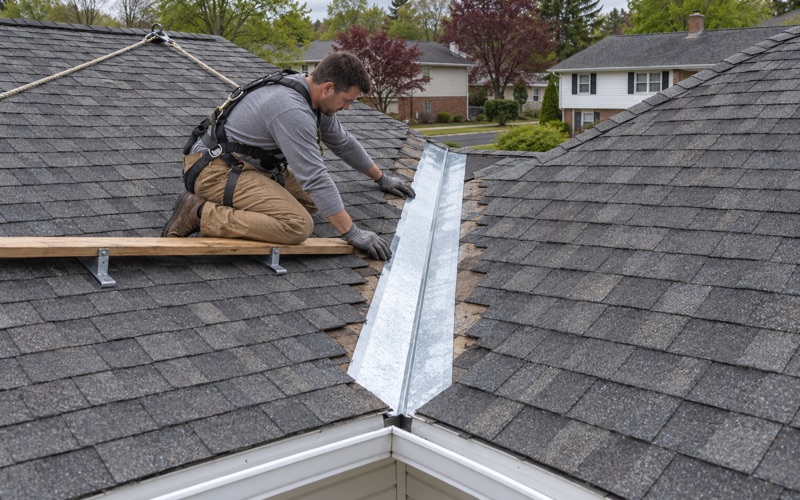
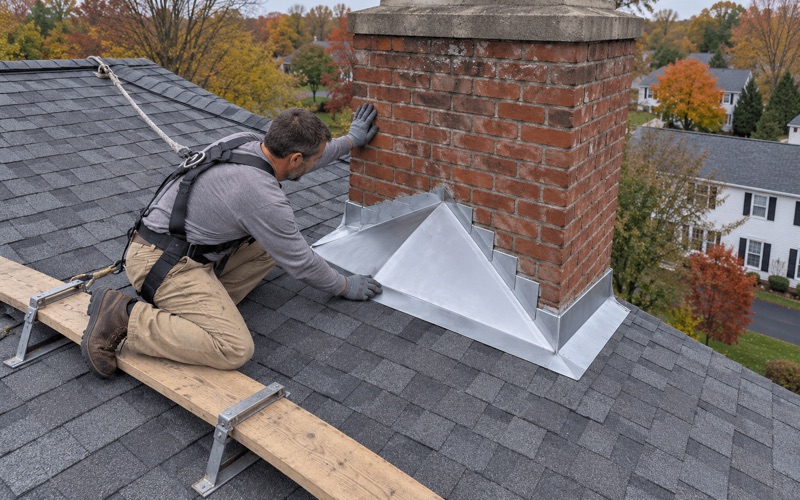
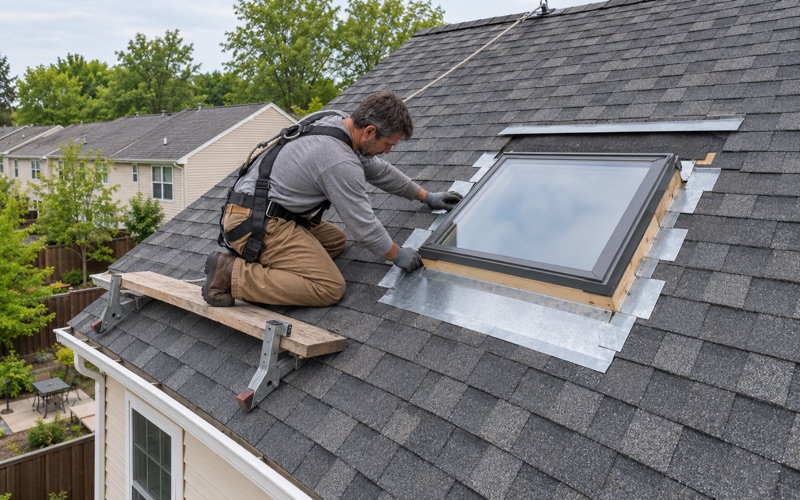
Each municipality also sets its own approach to re-roof work, so before pricing we check the rule that applies to your house with the Palmyra Borough Code Enforcement Agency, which administers the State Uniform Construction Code here. Flashing gets the same care wherever the house sits: step, counter and chimney flashing are replaced with a new roof, never reused under fresh shingles.
Where a storm check starts
If a wind like the April 1, 2023 downburst crosses the borough again, call us before the gutters start overflowing or a stain appears on a bedroom ceiling. We will start on the side that faced the wind, check the edges, rakes and ridge, go into the attic, and tell you plainly whether you are looking at a repair or something larger.
- 20+ Years Experience
- Attic Checked on Every Leak
- Itemized Written Scopes