Bensalem Quality Roofing brings more than 20 years of experience to roofing in Moorestown, and on this side of the Delaware we write every job to New Jersey’s rules rather than Pennsylvania’s. That covers how the contract reads, how sales tax is handled, including the Form ST-8 capital improvement certificate where it applies, and whether any township review stands between a signed estimate and the first day of tear-off.
For many homeowners the answer is simple, but a growing number of older houses now carry an extra step. Since spring 2025 the township has had its own preservation review for a defined set of properties, and a roof is one of the first features it looks at. We check which category a house falls into before we price anything, because the review shapes the material, the schedule and the paperwork.
Our approach does not change with the address. Every estimate arrives as a written scope that breaks tear-off, decking, underlayment, flashing, ventilation and gutters into separate lines, so nothing is folded into a single lump sum. That makes a historic review application easier to prepare and two estimates easier to compare.
Moorestown’s Historic District and the Houses It Covers
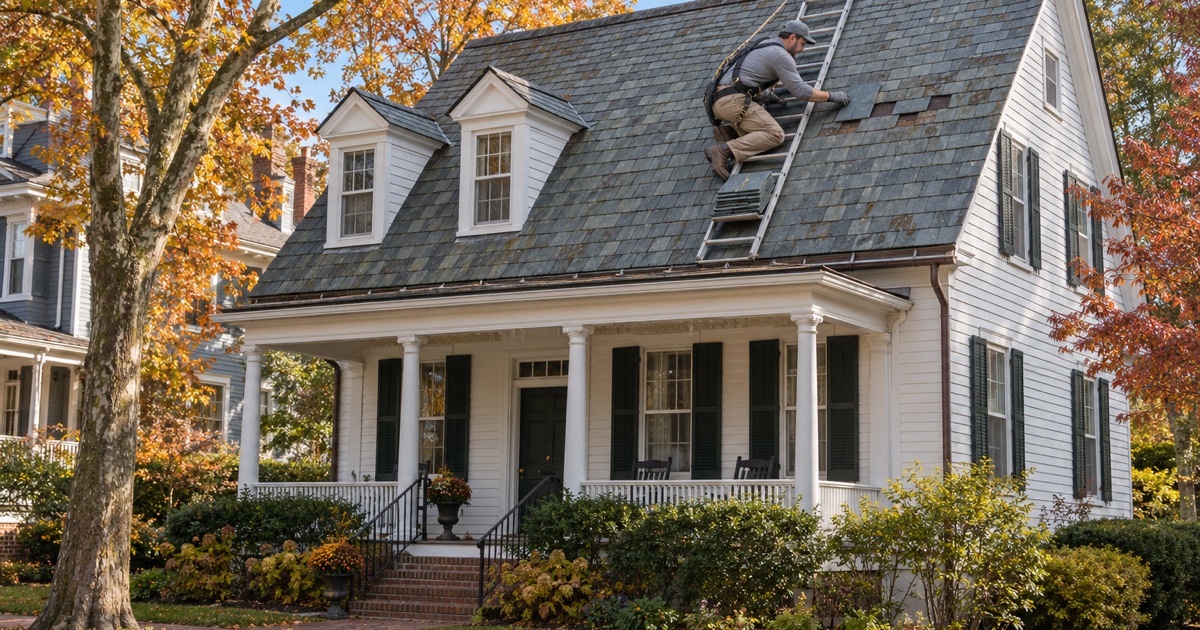
Moorestown Township created a Historic Preservation Commission through Ordinance 6-2025, which became Code Chapter 96 when Township Council passed it on April 7, 2025. The Commission has five regular and two alternate members, and the township Zoning Officer serves as its Administrative Officer. For properties inside the district and at the designated sites, it replaces the old township Appearance Committee.
Main Street, Chester Avenue, Mill Street and High Street
The Historic District is listed address by address in Appendix A of the ordinance, roughly 120 rows along East and West Main Street, Chester Avenue, Mill Street, High Street, East and West 2nd Street and Page Lane. Each row is marked Contributing or Non-Contributing, and the period of significance runs from circa 1720 to 1940. If your house is on one of those streets, the list is the first thing we read.
Preservation New Jersey reported that the push for the district followed the threatened demolition of 204 and 210 Main Street, after an earlier 2006 effort was unraveled by legal challenge. The same report noted that homeowners who consented to inclusion could enjoy a tax break. Neither point changes how a roof is built, but it explains why the review now exists and why it is taken seriously.
The seven individually designated Historic Sites
Appendix B adds seven Historic Sites that stand outside the district list. They include the Perkins House on Kings Highway, the Samuel Allen House known as Breidenhart on East Main Street, the Elisha Barcklow House and the Hillman House, or Indian Spring, on West Main Street, and the Commodore Truxton, Bispham and Walton House on Marne Highway. The Thomas Cowperthwaite House and the Thomas French House complete the group.
These houses carry the same certificate requirement as district properties, even when nothing around them is protected. A roof on a neighboring lot can be replaced without the Commission ever seeing it, while the listed house next door cannot. We confirm a site’s status with the township before we schedule work, rather than relying on what a previous owner remembered.
Most Moorestown roofs sit outside the district
Chapter 96 reaches only the Appendix A addresses and the seven Appendix B sites, so the large majority of homes in the township are not under historic review at all. Census figures count 5,996 detached houses among 8,397 housing units, and only a small share of them appear on the Appendix A list. For those owners the ordinary New Jersey rules apply.
Under New Jersey’s construction rules, re-roofing a detached one- or two-family house is ordinary maintenance and needs no construction permit. Attached homes, multifamily buildings and commercial roofs remain permit work, which matters for the township’s 1,238 attached units, and we plan townhouse and twin roofs with the neighbor’s roof and the shared wall in mind.
Looking for roofing closer to Collingswood? See Collingswood Roofing.
When a Roof Job Needs a Certificate of Appropriateness
Roofs are named first
Section 96-6A requires a certificate of appropriateness from the Commission before any township permit is issued, or before work starts when no permit is needed. It applies to any change to the exterior appearance of a building by addition, reconstruction, alteration or replacement, and the ordinance lists roofs first among the examples. That second clause is the one that catches people, because a re-roof that needs no state permit can still need township approval.
The ordinance also defines architectural features to include roofs, and states that a permit covers all exterior work on roofs. In practice, a roof in the district is reviewed as part of the building’s face, not as a hidden layer. We build the review time into the schedule from the first estimate so the start date is not a guess.
The ordinary maintenance question
Chapter 96 defines ordinary maintenance as repair or replacement with no change in design, material or appearance, and its own example is patching a dozen missing roof shingles. Section 96-6B(4) lists ordinary maintenance among the work that does not require a certificate. Section 96-7B, however, says an applicant for proposed minor or ordinary maintenance work shall apply for and receive a certificate from the Minor Work and Applications Subcommittee before starting.
Those two sections do not agree, and we do not pretend they do. Before we patch a roof on a listed property, we ask the Zoning Officer which reading the township applies to that job and keep the answer with the file. A phone call costs nothing, while penalties under Section 96-12D run up to $750 a day for the first ten days, $1,000 a day for days 11-25 and $1,250 a day after that.
What the Commission measures a roof against
Section 96-8C(4) requires that all exterior elevations, including the roof, be maintained, and that in-kind or similarly compatible building materials be used. Until the township adopts its own Historic Design Guidelines, the Commission relies on the Secretary of the Interior’s Standards. A draft of those guidelines was pending review and adoption, so we work from the ordinance and the Standards rather than guessing at rules not yet in force.
That approach suits the way we already document a roof. Photos of the existing shingles, slate, trim and flashing, along with a line-item scope, show the Commission exactly what is there today and what will replace it. A clear record of the existing roof is the strongest part of any application we help an owner assemble.
Matching the Existing Roof or Changing It
In-kind replacement and the seven-day Minor Work review
An in-kind replacement of roof material, trim, gutters or leaders, matched to the existing roof in design, material, shape, texture and appearance, is classed as Minor Work under Section 96-6C. The Minor Work and Applications Subcommittee can approve it without a public hearing. It must issue an approval, or a decision to schedule a hearing, within seven days of a minor application.
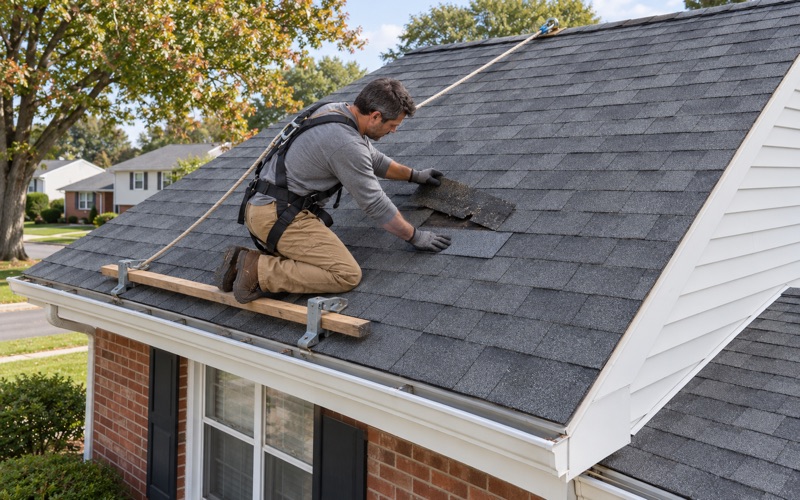
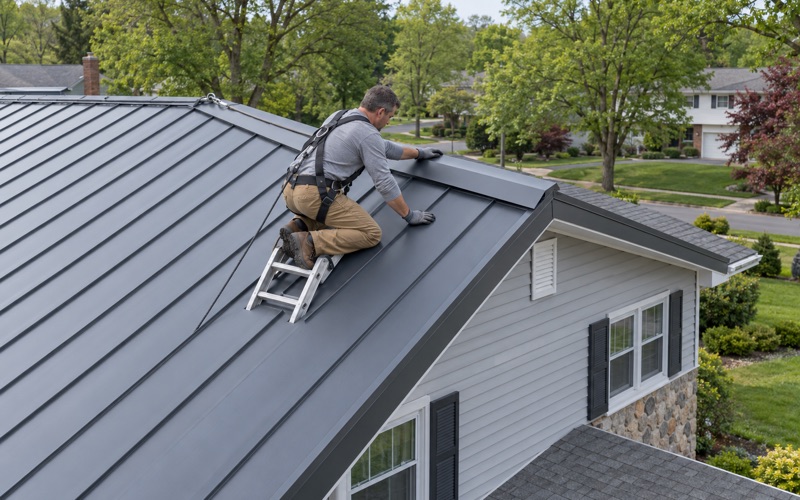
For most owners this is the track worth aiming for. When a worn roof can be replaced with a matching material, we specify the product and profile closely enough that the subcommittee can compare it line by line with the old one. Replacing architectural shingles with matching architectural shingles, or slate with matched slate, is the kind of job this track was written for.
Changing the roofing material goes to a full hearing
Anything that is not in-kind, such as swapping one roofing material for another, goes before the full Commission at a public hearing. Under Section 96-7D the Commission has up to 45 days from referral to deliver a written report, and failure to report within that window is deemed a report in favor of issuance. A certificate, once issued, is valid for one year with up to two one-year extensions.
We tell owners about that longer track before they choose a material, not after. If a change makes sense for the house, we prepare the scope and photos for the hearing and plan the start date around the full review period. If a matching material will serve the roof just as well, we say so plainly and leave the decision with you.
Gutters, leaders and trim count too
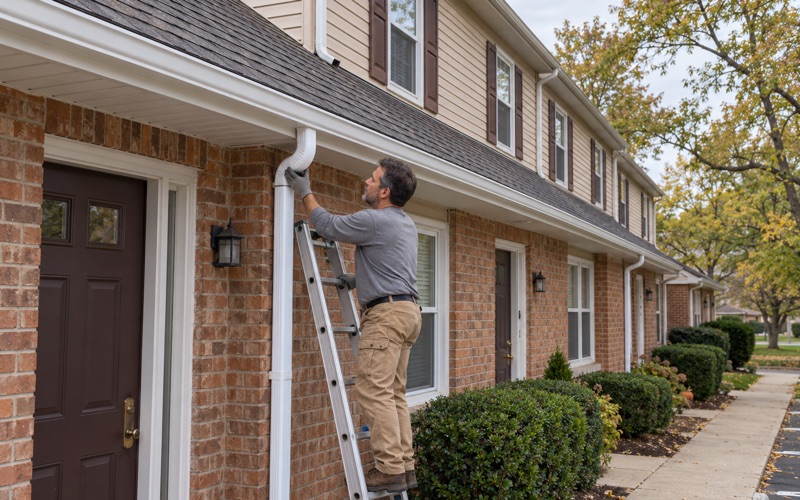
The Minor Work list names gutters, leaders, trim, molding and corbels alongside roof material, so the edge of the roof is reviewed with the roof. We size and pitch gutters and downspouts with the roof itself, and on a district house we match their profile to the existing work. Seamless aluminum gutters may suit one house and not another, and we raise that question before the application is filed.
Painted trim and fascia also bring lead into the picture. Census data shows 1,774 of Moorestown’s housing units were built in 1939 or earlier, and on any pre-1978 home we follow the EPA RRP lead-safe rule when that painted wood is disturbed. Careful containment and cleanup keep an old property safe while the work goes on.
Emergency Roof Repairs on a Moorestown Historic Property
Keeping a house habitable first
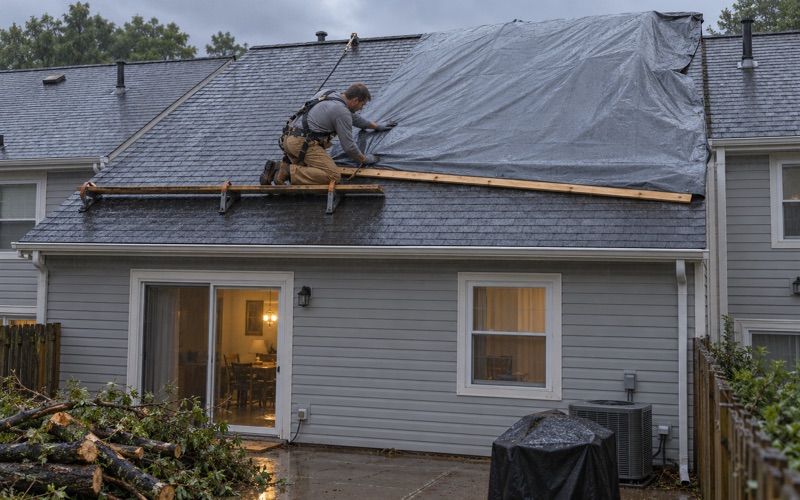
Section 96-6D allows emergency repairs that preserve habitability or health and safety to go ahead without first obtaining a certificate of appropriateness. That allowance is strictly limited to what the emergency requires, and a request for Commission review must be made at the same time the emergency work begins. In our reading a tarp and a temporary seal over an open roof fit that description, while a full replacement is a separate application.
When a storm opens a roof on a district property, we stabilize it, file the review request alongside the work, and photograph the damage for the owner’s own insurance claim. If you ask, we will meet the adjuster on site, though we do not negotiate the claim. The permanent repair then goes through the normal Minor Work or hearing track.
Tracing the leak and pricing the repair honestly
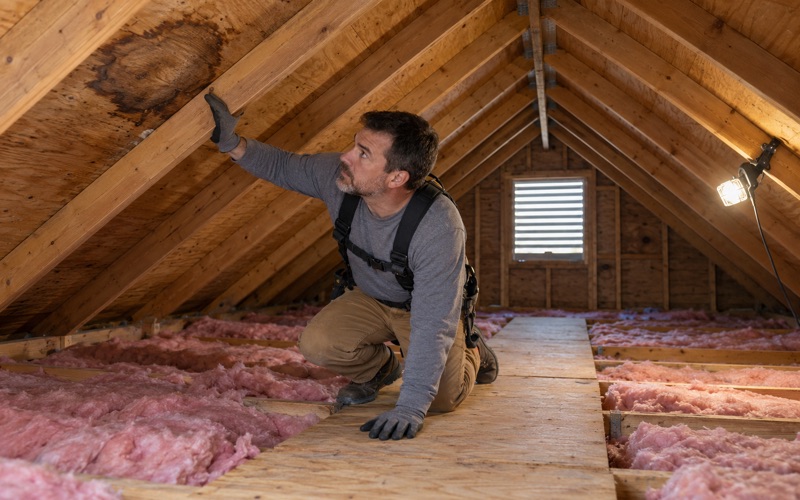
Water rarely enters where the ceiling stain appears, and on an older house it can travel along framing for several feet. That is why every leak call includes a look in the attic as well as on the roof, so we find the real entry point before anything is priced. On a historic property, a narrow repair aimed at the actual source is also the easiest kind to explain to the township.
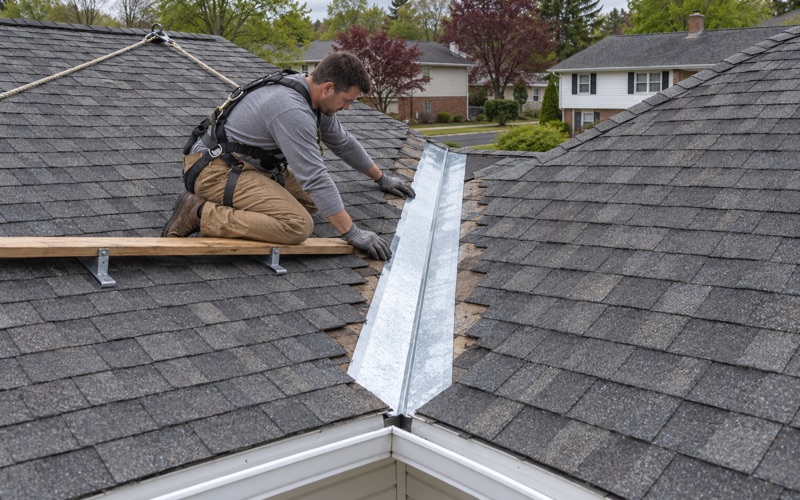
We give a straight answer on whether a roof can be repaired before replacement is ever discussed. Many older roofs fail at a valley, a chimney or a single run of flashing while the field is still sound. When that is true, a targeted repair keeps the most original material on the house and the job smaller.
Scope, decking and flashing on an older roof
Once an old roof is off, damaged decking is photographed and shown to you before it is replaced, at a per-sheet price already set in the contract. On a house from the period of significance, that board-by-board record also documents what was found under the old covering. No owner should learn about rotten sheathing from a final invoice.
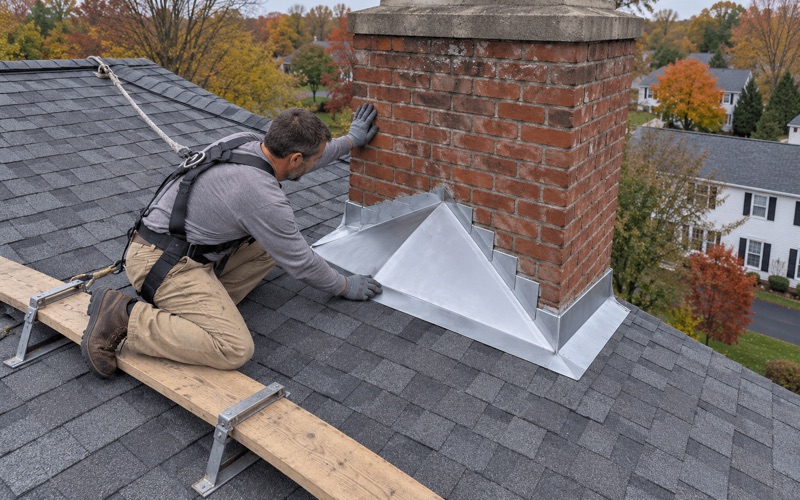
Step, counter and chimney flashing is replaced with the roof rather than reused under new material, because tired flashing is where many leaks on older chimneys begin. Where the Commission has approved an in-kind match, we keep new flashing consistent with that approval. At the end of every work day the driveway, yard and gutters are cleaned and swept with a magnet for stray nails.
- 20+ Years Experience
- Attic Checked on Every Leak
- Itemized Written Scopes