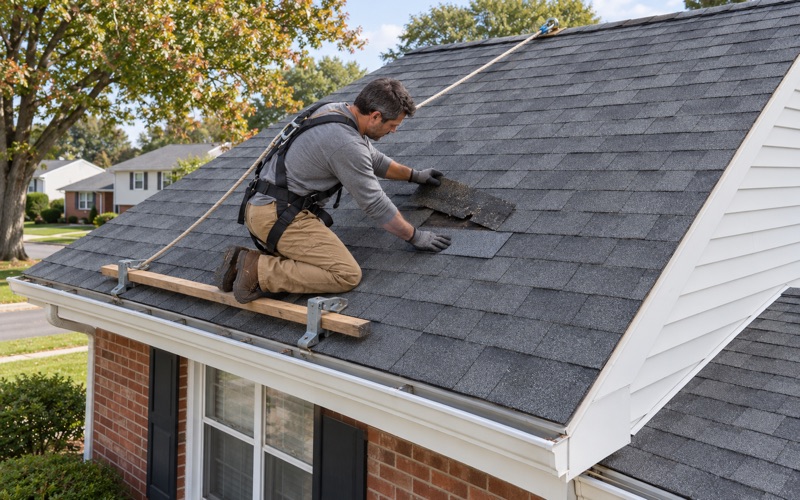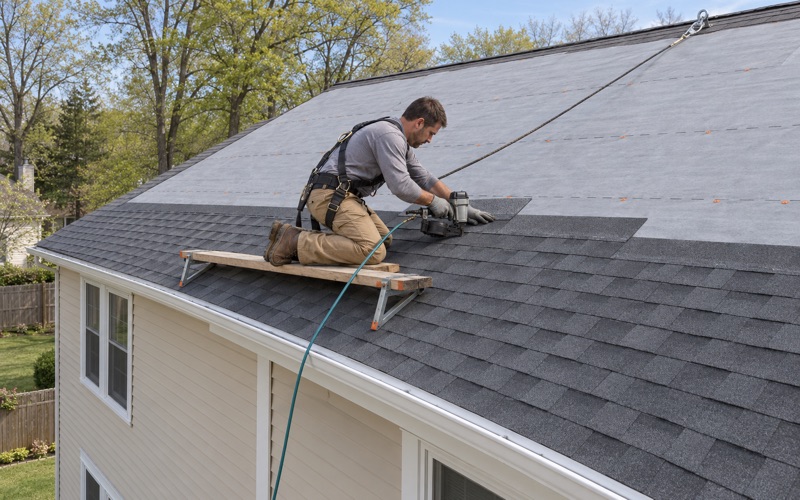
Bensalem Quality Roofing handles roofing in Middletown Township with more than 20 years in business behind every estimate, and the first job on any house is working out what its roof actually needs. Some homes need a quick repair and nothing more. Others need a full tear-off planned around a raised foundation, a flood history and an insurance file, and those two jobs should never be priced the same way.
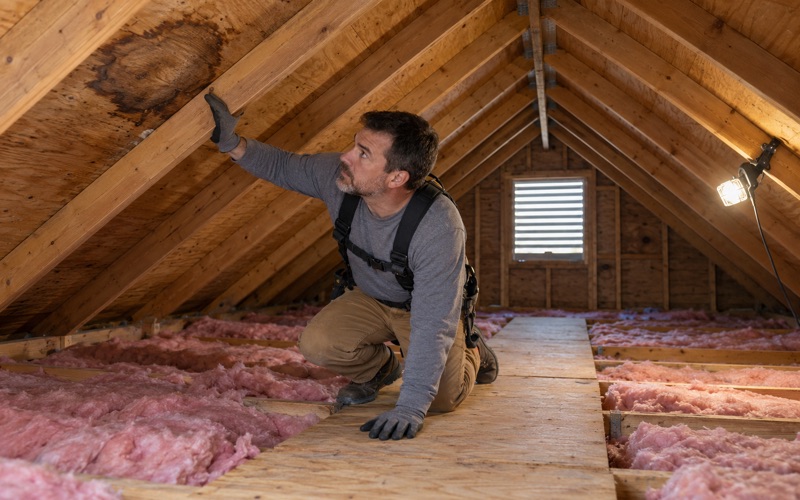
Every leak call starts with a look inside the attic as well as across the shingles, so we can follow the water to the spot where it really gets in. Only then do we put a number on anything. You also get a plain answer on whether the roof can be repaired before anyone on our crew raises the subject of replacement.
When replacement is the right call, the estimate breaks tear-off, decking, underlayment, flashing, ventilation and gutters into separate lines you can hold against any other bid. Our contracts follow the Pennsylvania home improvement law, which means a three-business-day cancellation notice and a deposit kept within the legal limit. Nothing about the paperwork should be a surprise later.
The Neshaminy at Langhorne: Bridle Drive at 9 Feet, Periwinkle at 13
The National Weather Service tracks Neshaminy Creek at a gauge near Langhorne, listed as LNGP1, and its impact statements are unusual because they name Middletown Township streets outright. For a homeowner near the creek, those numbers say more than any general talk about storms. They describe what the water has done to the houses nearby, which shapes what the roof above those houses has to handle.
Flooding Begins on Bridle Drive at 9 Feet
The gauge sets action stage at 8 feet and minor flood stage at 9. At 9 feet, the impact statement reads that flooding begins on Bridle Drive in Middletown Township. At 12 feet, moderate flood stage, widespread flooding makes Bridle Drive impassable, and well before that, at 10.5 feet, Route 413 near Bridgetown Pike becomes subject to closures.
That matters for scheduling as much as for the house itself. A tear-off needs a dumpster, a materials drop and a crew truck on the street for several days. When the creek is forecast to rise, we check the gauge before a delivery and will move a start date rather than leave shingles staged and a roof open on a road that may close.
Periwinkle Avenue at 13 Feet, Homes on Bridle at 14
At 13 feet, Periwinkle Avenue in Middletown Township begins to flood. At 14 feet, which is major flood stage, the statement says residential properties on Bridle Drive are flooded. Those are the creek’s own published thresholds, and they put two named streets at the center of the township’s flood story.
We never tell an owner what flood zone designation a street carries, because that is a question for the township and the federal maps rather than a roofer. What the gauge does show is which blocks have lived through repeated high water. Those are the houses where a roof estimate has to account for elevation work, insurance paperwork and drainage from the start.
Ida, Floyd and the 1955 Crest
The highest crest on the Langhorne gauge is 22.84 feet, recorded on August 19, 1955. Floyd put the creek at 21.91 feet on September 16, 1999, and Hurricane Ida reached 20.81 feet on September 2, 2021, the third-highest on record. The next two are 19.56 feet from August 2011 and 18.99 feet from June 1973.
After Ida, a Periwinkle resident told LevittownNow that most houses on Periwinkle and adjacent Bridle Drive have been elevated because of frequent flooding. Another neighbor reported four feet of water in a basement, and someone on Bridle had to be rescued by helicopter. Raised houses like those are where we spend the most planning time.
Looking for roofing closer to Mount Holly? See Roofing Services in Mount Holly.
Raised Houses and the County’s Neshaminy Program
Elevating a house changes almost everything about how its roof is reached, staged and drained. Along the Neshaminy, much of that elevation work came from one county effort. Knowing how that program worked helps explain the house shapes we see near the creek, and why a standard roofing plan rarely fits them without changes.
Buyouts and Elevations From Buckingham to Croydon
Bucks County began its Neshaminy Creek flood mitigation program after Floyd, and it closed in October 2014 after about $27 million, mostly federal money with state and county shares. Across the whole program, on properties from Buckingham to Croydon, it paid for 47 buyouts, 85 home elevations and 37 additions that lifted utilities.
Those totals describe the county-wide program, not a Middletown count, though the closing story named Bridle Drive and Periwinkle Avenue among the streets involved, along with Main Street in Hulmeville. CBS Philadelphia reported that elevation was judged more economical than buyouts and averaged about $175,000 per home. That is a serious investment to protect with the roof above it.
What Elevation Changes About Roof Work
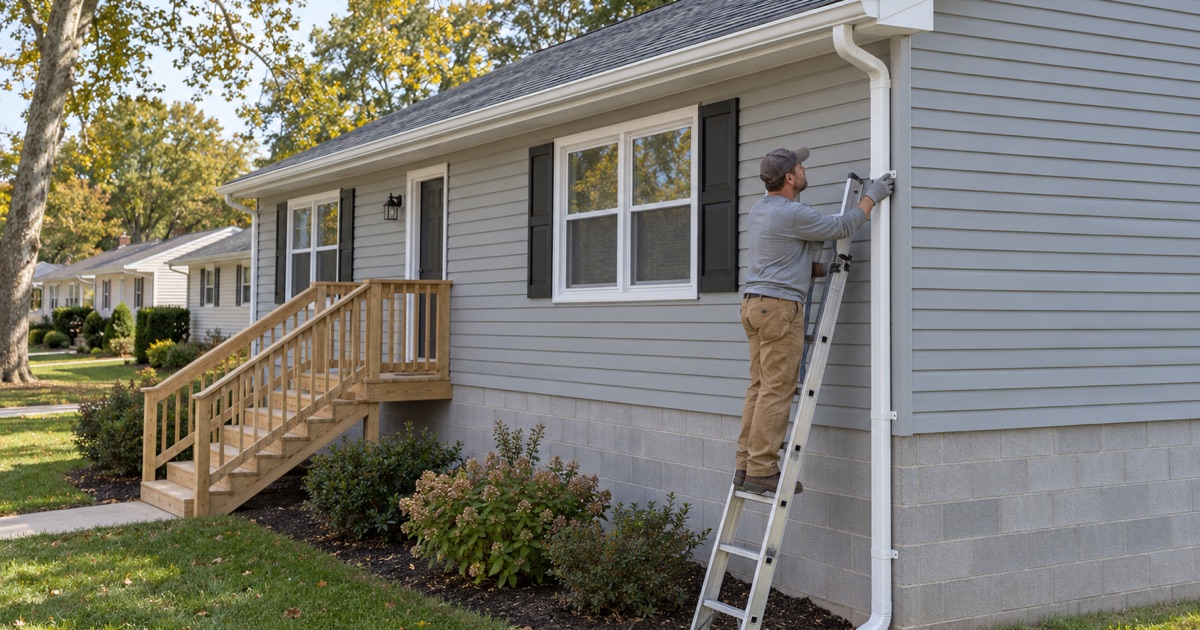
A raised house puts the eaves higher off the ground, so ladder placement, roof jacks, debris chutes and the dumpster position all change. We plan access around stairs, landings and the open space under the house instead of assuming a standard setup. The debris path is protected so nothing falls onto the lifted utilities below.
An elevation project usually leaves the roof itself alone, so the shingles, decking and flashing on a raised house can be older than everything beneath them. When the old roof comes off, damaged decking is photographed and shown to the owner before any sheet is replaced, at the per-sheet price already set in the contract. A surprise on the roof never becomes a surprise on the invoice.
Penetrations, Vents and Utilities
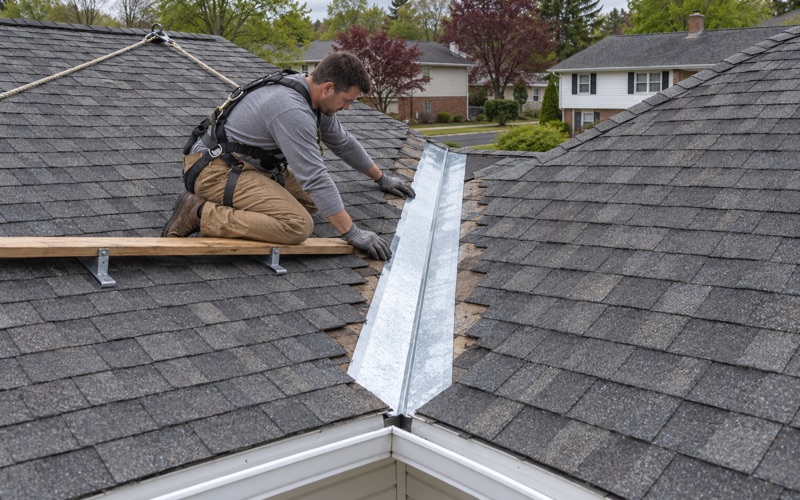
When utilities are lifted, vent pipes and exhaust runs can be rerouted, and each one that passes through the roof needs a sound boot. We replace pipe boots along with step, counter and chimney flashing as part of the new roof rather than reusing old metal under new shingles. Ventilation is checked as a system, with ridge vent balanced against soffit intake.
Why a New Roof Counts in the 50 Percent Test
For an owner whose house sits near the Neshaminy, the cost of a roof is not only a budget number. It can become part of a federal calculation that decides how floodplain rules treat the entire project. That makes the way an estimate is written almost as important as the price at the bottom of it.
The Substantial-Improvement Definition
FEMA defines substantial improvement as improvement work whose cost equals or exceeds 50 percent of the market value of the structure before the improvement starts. Cross that line and the project stops being judged as ordinary repair work. For a house that has already been raised once, owners usually want to know where they stand before anything is signed.
We cannot tell you where your house falls on that test. Market value comes from an appraisal or the assessor, and the decision belongs to the township, not to a contractor. What we can do is hand you a roofing cost that is accurate and clearly broken out, so the arithmetic is built from real numbers instead of a single lump sum.
What the Checklists Count
Local checklists built on FEMA P-758 list reshingling or retiling a roof among the costs counted toward the 50 percent figure, along with roofing, gutters and downspouts. Cleanup work such as covering a damaged roof is typically excluded. A tarp after a storm is one kind of cost, and a full replacement is another kind entirely.
That is why the order of work matters on a flood-prone house. If an owner is also planning siding, windows or interior repairs, the roof may be one line among several that add up. We suggest raising the plan with the township before committing to anything large, and our scope is written so it can go straight to whoever reviews it.
A Scope Written Line by Line
On most houses, our line-by-line format simply lets an owner compare two bids item by item. Near the creek that layout does more. Each line can be weighed on its own if a reviewer needs to know exactly what portion of a larger project is roofing and what is not.
Checking With Middletown Township Building & Zoning
Middletown Township keeps its floodplain chapter in the code of ordinances, and we have not read it, so we never guess whether improvements are added up across years. The Department of Building & Zoning at the Municipal Center, 3 Municipal Way, Langhorne, is the office to ask, at (215) 750-3800 extension 1112.
Permits get the same treatment. Each township and borough we serve sets its own re-roof rule, and Middletown’s 2026 fee schedule has no roofing line, so we confirm the rule for this house with the township before pricing. The schedule does say fees double when permit work starts before a permit issues, which is reason enough to ask first.
Gutters, Downspouts and Drainage on a Raised House
Gutters and downspouts appear on those same FEMA-based checklists, and on a raised house they work harder than usual. Water leaving the roof falls farther before it reaches the ground. Where it lands matters a great deal for a foundation that may already have seen creek water more than once.
Sizing and Pitch Planned With the Roof
We size and pitch seamless aluminum gutters as part of the roof design, not as an add-on at the end. The roof area draining to each run sets the gutter width and the number of downspouts, and the pitch keeps water moving instead of standing. Drip edge at the eaves sends runoff into the gutter rather than behind it.
Kick-out flashing goes wherever a roof edge meets a wall, such as where a lower roof over a stair or porch ties into the main house. Without it, water runs down the siding and into framing. On a house lifted to stay dry, letting the roof undo that work would be a poor trade.
Where the Downspouts Discharge
On a lifted house the downspouts are longer and more exposed, so we anchor them firmly and plan extensions that carry water away from piers, foundation walls and the space beneath the floor. Where utilities sit on raised platforms, discharge points are kept well clear of them.
At the end of each work day the driveway, yard and gutters are cleaned, including a magnet sweep for roofing nails. Under a raised house that sweep covers the open area below as well, since nails and shingle scraps collect there easily and are hard to spot.
After a Storm or a High-Water Event
When wind or a storm damages a roof, we photograph the damage and write it up for the owner’s own claim. If asked, our crew will meet the insurance adjuster on site, though we never negotiate the claim. Pennsylvania reserves that role for public adjusters licensed under its Public Adjuster Licensing Law.
Flood insurance questions belong with the owner’s agent and adjuster, and we keep our role to the roof. What we bring is a clear record of what was found, photographed from the attic and from above, and an honest read on whether a repair will hold. On a raised house near Bridle Drive, a smaller sound repair can keep the whole project simpler.
- 20+ Years Experience
- Attic Checked on Every Leak
- Itemized Written Scopes