Bensalem Quality Roofing brings more than 20 years in the trade to roofing in Lansdale, and the roofs we think hardest about here are the ones over many households at once: apartment blocks, converted multi-unit buildings and long rows of attached homes. When one of those roofs fails, the problem is never a single family’s ceiling stain. It is a building full of people who need somewhere to sleep that night.
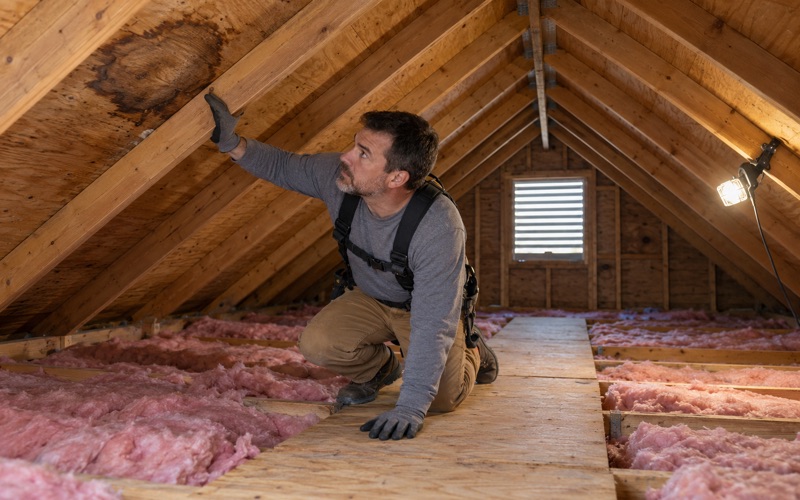
Our first visit to any leak or storm call covers the roof surface and the attic or plenum space beneath it, because water on a low-slope roof often travels well past the spot where it entered before it shows on a ceiling. We trace it to the actual opening first, and we tell the owner plainly whether a repair will hold before anyone talks about replacing the whole roof.
This page walks through the storm that took part of an apartment building roof off in this borough, why wide flat and low-slope roofs tend to fail from the edge inward, what happens to tenants when one does, and the perimeter checks that lower the odds of it happening again.
June 3, 2020: an apartment roof blown off in Lansdale
What the Storm Prediction Center logged
The Storm Prediction Center keeps a public log of severe wind reports, and its file for June 3, 2020 carries a row for Lansdale, Montgomery County, timed at 12:07 p.m. The comment on that row is short: a portion of an apartment building roof blown off.
The next day 6abc reported that the storms had damaged the roof of a 150-unit apartment complex in the borough. The station did not name the complex, and neither do we. What matters for anyone who owns or manages a multifamily building here is how ordinary the setup was: an occupied building, a weekday afternoon, and a roof that let go.
The storm line across Montgomery County
The Lansdale report was one of 24 Montgomery County rows in the same day’s file, as a fast line of severe storms crossed the county that afternoon. The log includes wind measured at 76 mph at Pottstown and a fatal tree that came through a building roof near Lower Moreland. Three people died in Montgomery County in those storms.
A storm line like that does not pick its targets by roof age or material. It finds the building where the edge detail was weakest on the day, and in a borough with this much multifamily housing, that building can hold a great many households.
What the record does not say
No wind speed was measured in Lansdale itself, and the record does not count how many roofs in the borough were damaged. We will not put a number on either. When we talk with an owner about storm risk, we use what the reports actually say, and we treat the forecast zone the National Weather Service assigns the borough, PAZ104 Eastern Montgomery, as the place to watch for warnings rather than as a climate record.
Lansdale is a densely populated commuter town, with many residents riding SEPTA’s Lansdale/Doylestown Line to Philadelphia each day, and the whole borough fits inside 2.99 square miles. That density is why a single building’s roof can become a matter for borough emergency management rather than one owner’s repair bill.
Looking for roofing closer to Palmyra? See Roofing in Palmyra.
Why large flat and low-slope roofs peel from the edge
Wind pressure gathers at corners and perimeters
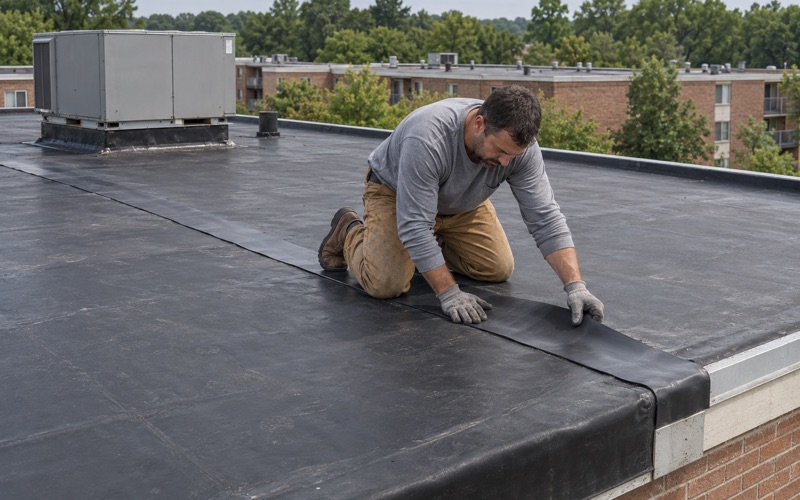
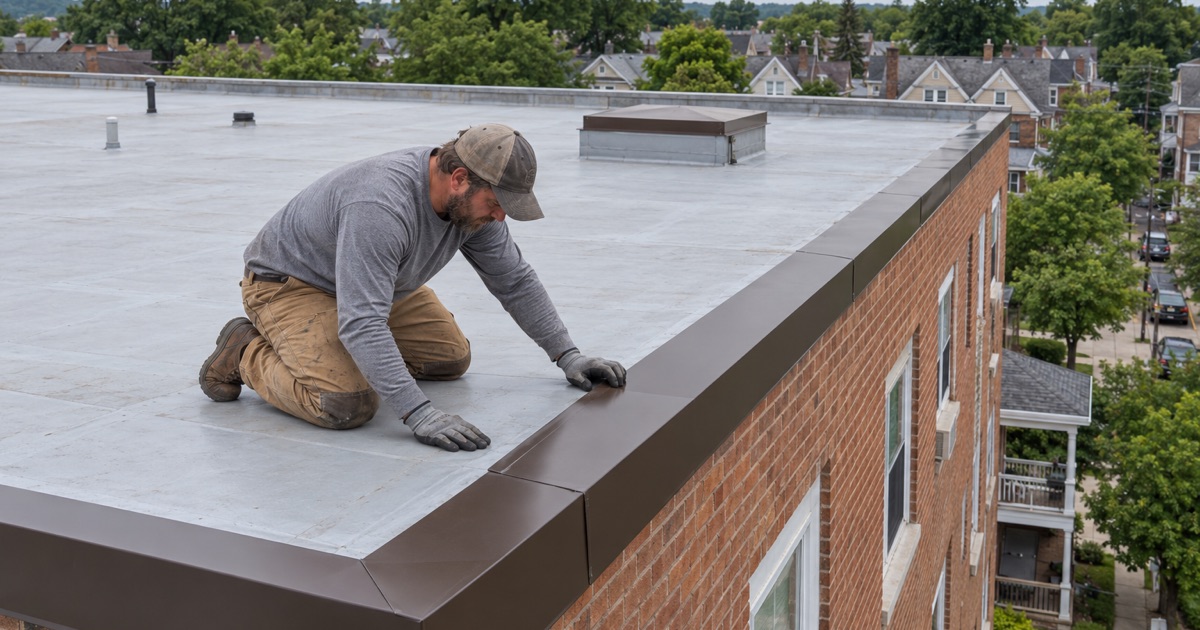
Wind moving over a wide, nearly flat roof creates uplift, and the suction is strongest along the perimeter and at the corners, where the airflow separates from the building. The field of the roof, out in the middle, sees much less. That is why so many membrane failures start as a lifted corner or a loose strip of edge metal and spread from there.
Once wind gets under the edge, the membrane acts like a sail. A single-ply sheet of EPDM, TPO or PVC, or a modified bitumen system, can peel back across insulation boards in seconds if the perimeter attachment gives way, and the opening it leaves is the full width of the tear.
Edge metal and the membrane termination
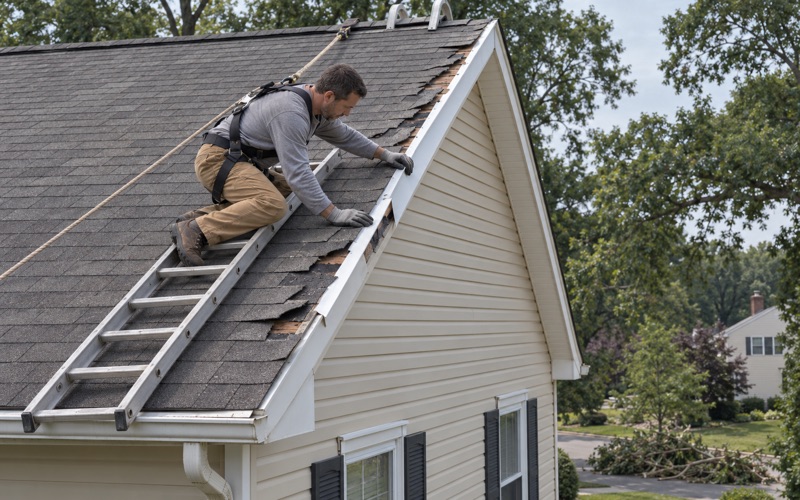
The edge metal at the top of the wall, whether a gravel stop, a drip edge or a coping cap over a parapet, is what holds the membrane’s outer termination down. If its fasteners have backed out, its cleat has rusted, or its joints have opened, the membrane behind it is only as secure as the adhesive left underneath.
We look at how the edge was fastened, not only whether it looks straight from the ground. Bent metal, gaps at the joints, and sealant that has shrunk away from the flashing are all signs that the perimeter is carrying less load than it was built to carry.
Older buildings and newer roof systems
Lansdale’s housing stock skews older: 1,946 housing units were built during 1939 or earlier, and 3,016 more went up between 1950 and 1969, according to the Census Bureau’s 2024 American Community Survey. Many of those buildings have been re-covered more than once, and each new layer can leave the edge detail thicker, taller and harder to fasten into solid wood.
When a tear-off exposes rotted nailer boards or decking along the perimeter, we photograph it and show the owner before replacing it, at the per-sheet price already written into the contract. Rebuilding the wood the edge metal fastens into is often the part of a re-roof that most affects how the next storm goes.
When a roof failure displaces a building’s tenants
Emergency management and the Red Cross
After the June 3 storm, 6abc reported that the Lansdale Borough Emergency Management Agency was working with the Red Cross to coordinate housing for a large number of displaced residents. That is the step most owners never picture until it happens: once water is coming through ceilings across several floors, the building may not be fit to occupy, and the tenants have to go somewhere.
The borough’s housing mix explains why the stakes are high. Of 7,330 occupied homes, 3,279 are rented, which is 44.7%, and 1,720 units sit in buildings of five or more, including 759 units within buildings of 50 or more. One roof on a large building can cover more households than an entire street of single homes.
Getting the building dry and covered
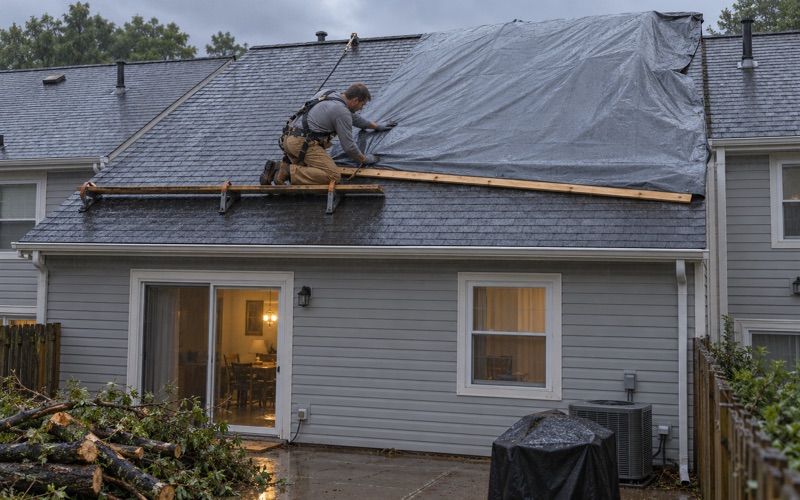
Our first job on a damaged multifamily roof is to stop more water from getting in, with temporary covering secured well back from the torn edge so the next gust does not lift it too. Then we trace the water inside, through the top-floor ceilings and any attic or plenum space, so the owner knows which units took water and where it entered.
Only after the roof is closed in do we give a straight answer on repair versus replacement. A torn perimeter on an otherwise sound membrane can sometimes be rebuilt and re-terminated; a roof that has been saturated across its insulation usually cannot, and we say so plainly.
Paperwork for the owner’s claim
We photograph storm damage and write it up for the owner’s own insurance claim, from the lifted edge metal to the wet insulation and the interior stains. If the owner asks, our crew will meet the adjuster on site to walk the roof together. We do not negotiate the claim; that stays between the owner and the insurer.
For the owner, the useful record is a dated one: photos taken before the temporary covering goes on, notes on which units reported water, and a written scope for the permanent fix. That record helps when tenants, the insurer and the borough each ask what happened and when the building will be ready.
Checking perimeter flashing and edge metal before storm season
A walk of the full perimeter
A pre-season check on a low-slope roof starts at the edge and works inward. We walk the whole perimeter, test the edge metal and coping for movement, look at every seam within a few feet of the edge, and check the flashing where the roof meets parapet walls, stair bulkheads and rooftop equipment curbs.
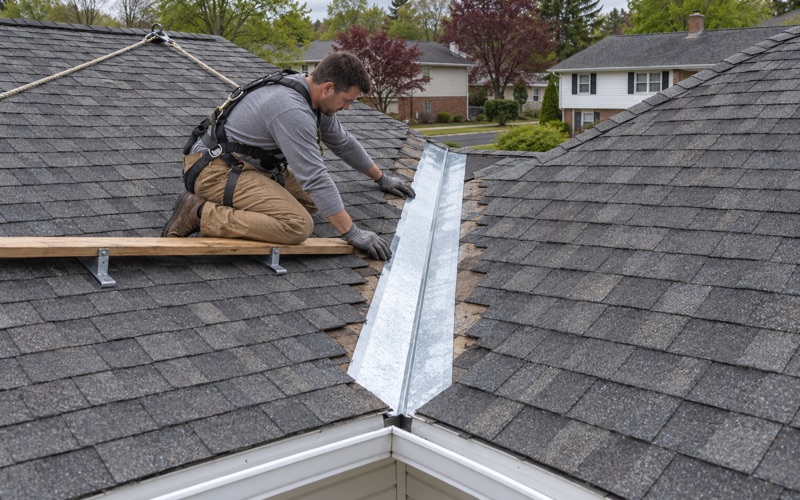
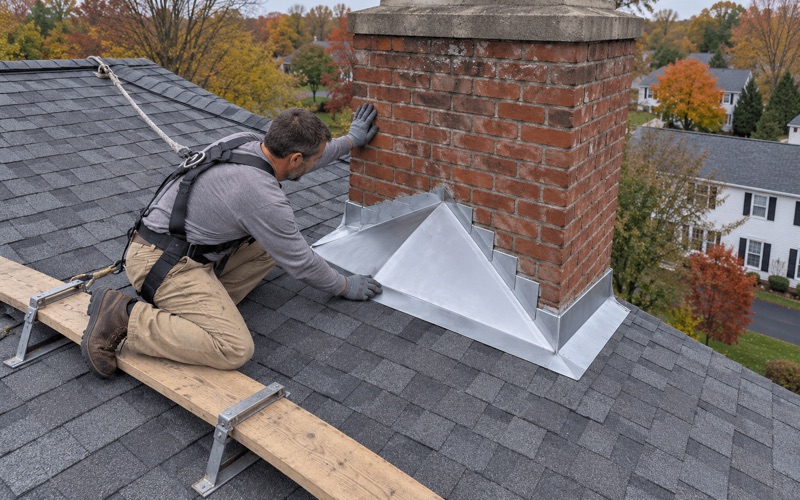
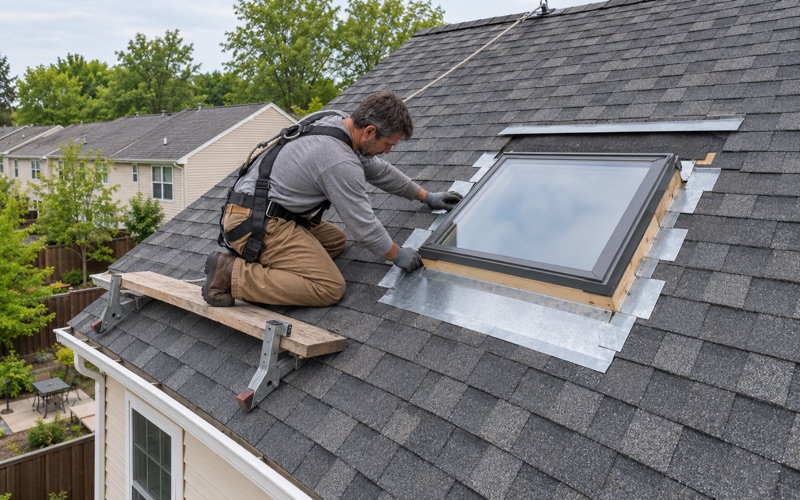
Flashing gets the same treatment on a pitched roof. On the borough’s many attached homes and twins, the step and counter flashing along a shared wall is where wind-driven rain finds its way in, and when we re-roof one side we plan the work around the neighbor’s roof so the joint between them stays sealed. We replace step, counter and chimney flashing with the new roof rather than reusing it.
Drainage and the signs inside
Water that cannot leave a flat roof quickly adds weight and finds weak seams. We check scuppers, gutters and downspouts as part of the roof, sizing and pitching them to the area they drain rather than treating them as a separate afterthought.
Interior signs count too. Stains on top-floor ceilings, damp insulation in the plenum, and leaks that only appear during wind-driven rain all point back toward the roof edge, and we trace each one from inside as well as from above.
Permits through the Lansdale Code Enforcement Office
Each Pennsylvania municipality sets its own re-roof permit rule, so we check the rule for the property’s own borough or township before pricing a job. The Lansdale Code Enforcement Office, at One Vine Street, lists roofs among the repair and replacement projects that need a permit, and its roofing permit application covers both flat and pitched roofs and asks for a copy of the written proposal or contract.
That request is one reason our written scopes list tear-off, decking, underlayment, flashing, ventilation and gutters as separate lines. An owner comparing two bids on a multifamily roof can see exactly what each one includes, and our Pennsylvania contracts carry the three-business-day cancellation notice the state’s home improvement law requires, with deposits kept within the legal limit.
At the end of every work day the crew cleans the grounds, gutters and parking areas, including a magnet sweep for roofing nails. On a property where many tenants walk and park each evening, a stray nail is a real hazard.
- 20+ Years Experience
- Attic Checked on Every Leak
- Itemized Written Scopes