Bensalem Quality Roofing has spent 20+ years on roofing in Hopewell Township and across our service area on both sides of the Delaware, and on wooded lots the work so often starts with the tree beside the house rather than the shingles under it. We cross the river to inspect, repair and replace residential roofs. Each New Jersey job is written to New Jersey rules instead of carrying Pennsylvania paperwork over the bridge.
Every leak call begins in two places: up on the roof and up in the attic. That way the stain on the ceiling is traced back to where water actually enters before we price anything. Then you get a plain answer on whether the roof can be repaired, and replacement only enters the conversation once a repair has honestly been ruled out.
This page is about the hazard a township of ridges, creek valleys and old hardwoods really poses to a roof. It covers the storm the National Weather Service traced across the township, what a falling limb does to shingles and decking, and how we check a roof afterward and prepare one before the next warning.
The July 29, 2021 Tornado from New Hope to Bear Tavern Road
What the National Weather Service survey recorded
On July 29, 2021, the National Weather Service office in Mount Holly confirmed 10 tornadoes across its area and described the day as the largest local outbreak in modern times. One of them formed near New Hope, Bucks County, crossed the Delaware River into Washington Crossing and finished its run inside Hopewell Township. The survey rated it EF-2, with an estimated peak wind of 120 mph for the path as a whole.
The survey numbers are compact. The tornado traveled 6.4 miles, was up to 400 yards wide, and covered that distance in 15 minutes from touchdown to lift. It came from the same supercell that produced the Plumstead Township tornado on the Pennsylvania side.
Baldpate Mountain to Bear Tavern Road
After crossing the river, the survey says, the tornado continued southeast and crossed Pleasant Valley Road, where the first EF-2 damage was found. From there it moved onto Baldpate Mountain, and the wording for the mountain is blunt: hundreds of trees were snapped or damaged there.
Damage continued down the mountain through Fiddlers Creek Road and Church Road, and more was observed just southeast along Bear Tavern Road. The tornado is estimated to have lifted before it reached the densely populated area near Trenton-Mercer Airport. The survey recorded no fatalities and no injuries.
A storm measured by its trees
Read the whole Hopewell Township section and one thing stands out: it describes trees, not buildings. No sentence in it mentions a house, a roof or any other structure. The survey team measured this tornado by what it did to the woods, because the woods are what stood in its path.
That is not a promise that every roof in the township came through untouched, and we make no claim about what happened on any single property. It is a description of where the danger concentrates in a place like this. On a wooded lot, the storm hazard to a roof is mostly the tree standing over it.
Looking for roofing closer to Plymouth Township? See Plymouth Township Roofing.
Church Road, Titusville and the Trees Over a Roof
What Church Road looked like the next day
The day after the storm, 6abc reported from Church Road in Titusville, where residents faced a long cleanup. Dozens of trees had been uprooted, some dangling from power lines and others covering parked vehicles, and witnesses described a large tornado on the ground. One resident told the station that not one single tree hit the house.
That line captures the township’s real exposure better than any wind figure. The storm did its work through trunks and limbs, and whether a house was struck came down to which way each tree fell. The article reported no rating and no roof damage, so we take it for exactly what it says.
Why a wooded lot changes the inspection
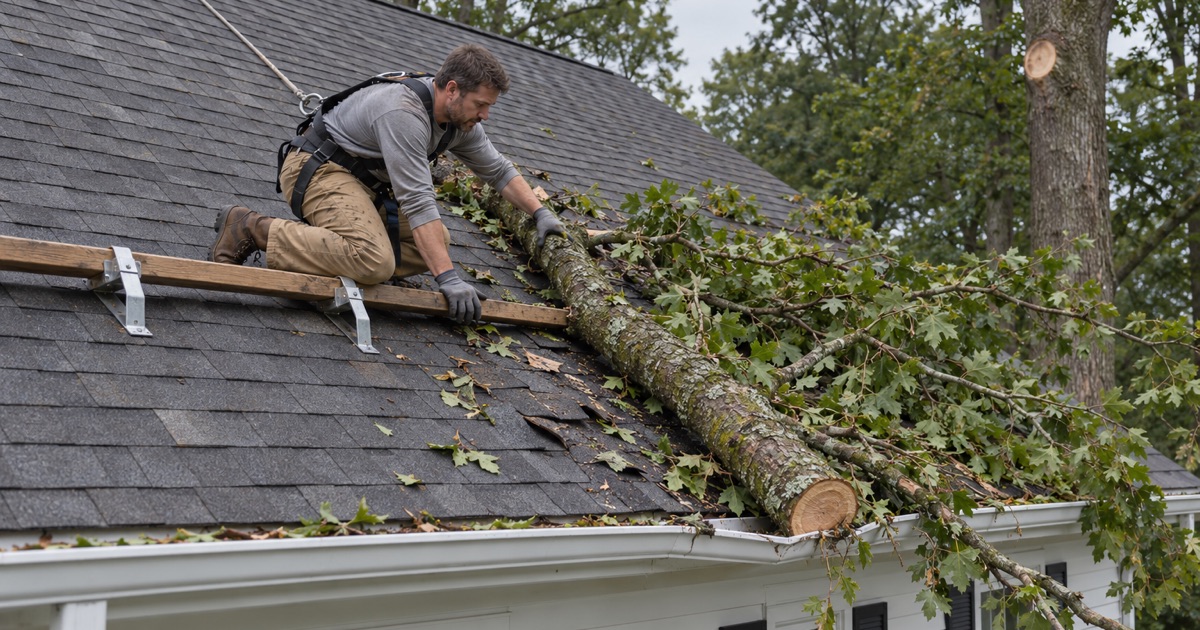
On an open street, wind damage to a roof usually means lifted or creased shingles along the edges and the ridge. Under mature trees the pattern is different. A falling limb strikes one spot hard, can crack the decking beneath it, and may leave shingles that look intact from the ground but have been punched through or split along a rafter line.
Smaller debris matters too. Twigs and leaf mats pile up in valleys and behind chimneys, hold water against the shingles and clog gutters, so a roof that survived the storm can start leaking weeks later. On a wooded property we look for both kinds of trouble: the obvious impact and the slow backup that follows it.
Shingles that handle debris and wind better
No shingle survives a falling trunk, and we will not pretend otherwise. What material choice can change is how a roof handles lighter blows and the wind that comes with them. Shingles tested to UL 2218 Class 4 impact resistance are built to take hard hits better than standard products, and a rating such as ASTM D3161 Class F addresses wind uplift.
Architectural shingles such as GAF Timberline HDZ, Owens Corning Duration and CertainTeed Landmark are common choices for a re-roof. Ratings vary from one product to the next, so we check which wind and impact ratings a specific shingle actually carries before you choose. The decision gets made on the label rather than on a brochure.
Checking a Roof After Limbs Come Down
Safety first, then the roof
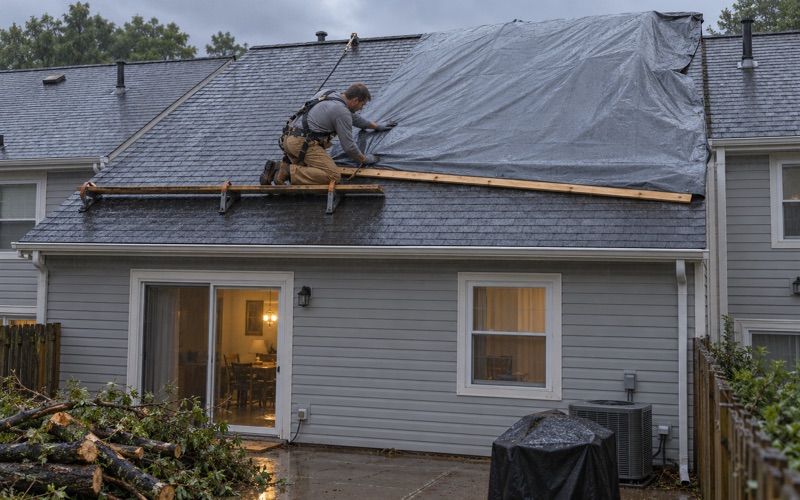
If a tree or a heavy limb is resting on the roof, the first call is about the tree, not the shingles. A trunk lying across a roof can shift as it is cut, and one tangled in a service line is a matter for the utility. Once the weight is off and the lines are safe, we can get up and see what the impact left behind.
Until then, the useful work happens indoors. Move belongings away from any wet ceiling, set a bucket under the drip, and photograph every stain and every piece of debris on the roof you can see from the ground. Those pictures help later, when the damage has to be explained to someone who was not there.
Roof and attic, side by side
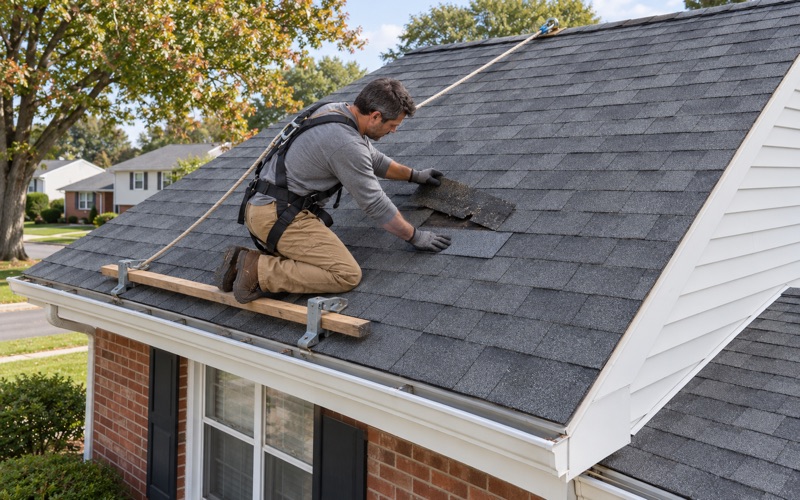
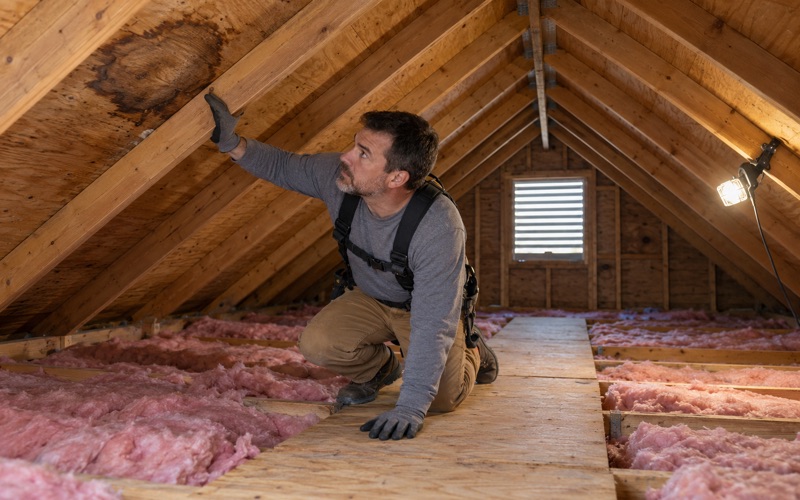
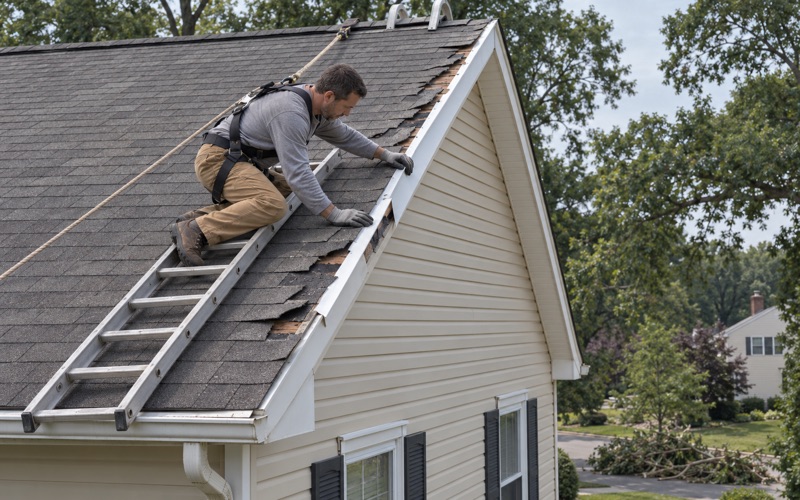
After a limb strike our inspection covers both faces of the roof deck. On top we look for punctures, cracked or split shingles, bent drip edge, crushed ridge vent, torn pipe boots and flashing pulled away from walls or chimneys. In the attic we study the underside of the same spot for split sheathing, daylight and fresh water staining.
The attic often tells the truer story. A shingle can lie back down after a blow while the board beneath it has cracked, and that crack is where the next heavy rain gets in. Tracing the water from the inside is how we tell you whether a patch will hold or the whole section has to come apart.
Photos, a written scope and the insurance claim
When storm damage is real, we photograph it and write it up so you can file your own claim with documentation in hand. If you ask, a member of our crew will meet the adjuster at the house to point out what we found. We do not negotiate the claim for you; that conversation stays between you and your insurer.
The scope we hand you breaks the work into separate lines: tear-off, decking, underlayment, flashing, ventilation and gutters. That lets you hold our estimate next to an adjuster’s figure or another roofer’s quote and compare them item by item, instead of weighing two single totals against each other.
Trees Over the House Before the Next Warning
Look up before the storm does
Hopewell Township sits in National Weather Service forecast zone NJZ015, served by the Mount Holly office, and that is where any warning for the township comes from. A warning gives minutes, not days. The time to deal with a tree over the roof is a calm afternoon long before one is posted.
Walk the property and look up. Limbs that reach over the roof, trunks leaning toward the house and dead wood high in the crown are the likeliest to come down in a strong wind. A tree professional is the right person to judge a tree’s health; our part is telling you what the roof under it would need if it ever came down.
What we change on a roof under heavy canopy
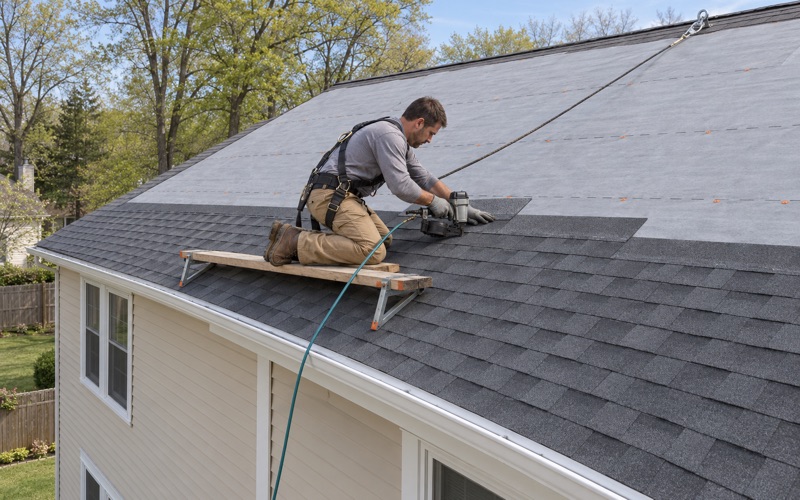
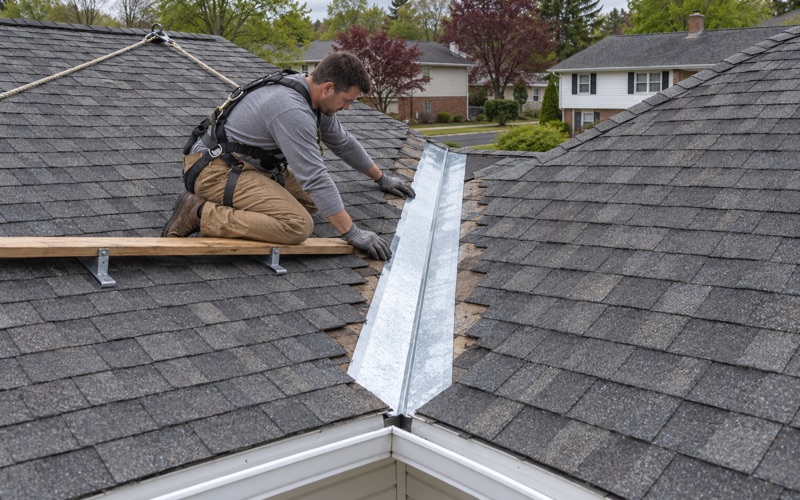
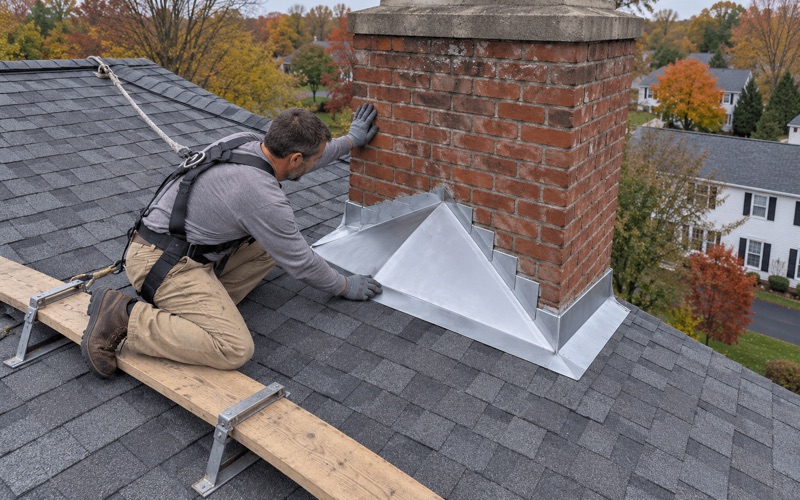
When we repair or replace a roof beneath mature trees, a few details earn extra attention. Step flashing, counter flashing and chimney flashing are replaced with the roof instead of being reused under new shingles, because those joints are where wind-driven debris and trapped water find a way in. Valleys can get a self-adhering ice and water barrier meeting ASTM D1970 where leaf mats tend to sit.
If decking turns out to be damaged once the old roof is off, as it can be where limbs have struck before, we photograph it and show it to you before replacing any boards. The price per sheet is already written into the contract, so that discovery never turns into a surprise on the invoice.
Gutters, cleanup and New Jersey paperwork
Trees and clogged gutters go together on every wooded lot. We size and pitch gutters and downspouts with the roof rather than as an afterthought, so a heavier load of leaves and runoff has somewhere to go. At the end of each work day the driveway, yard and gutters are cleaned, including a magnet sweep for roofing nails in the grass.
Because the house is in New Jersey, the contract and sales tax are handled under New Jersey rules, not the Pennsylvania rules we use at home in Bensalem. Before pricing, we also confirm what the Hopewell Township Construction Department expects for the specific work, since each municipality we serve sets its own approach.
Whether the next storm brings a limb down or simply passes over, the call works the same way. We look at the roof and the attic, tell you plainly what we see, and put the plan in writing before any work begins.
- 20+ Years Experience
- Attic Checked on Every Leak
- Itemized Written Scopes