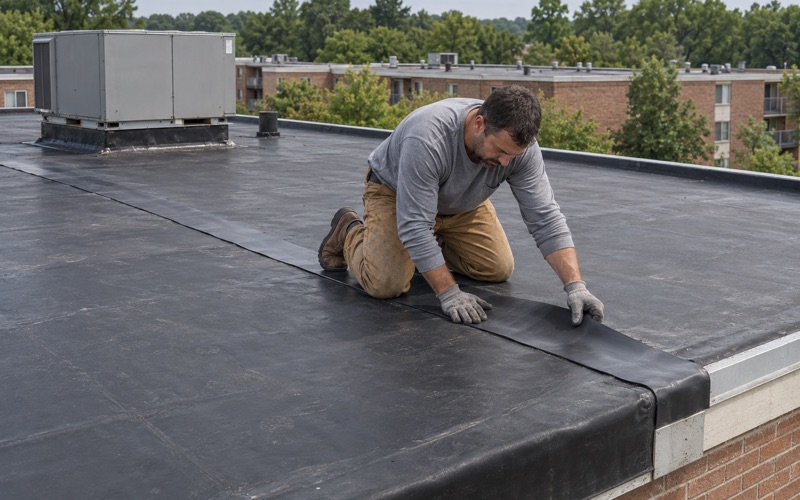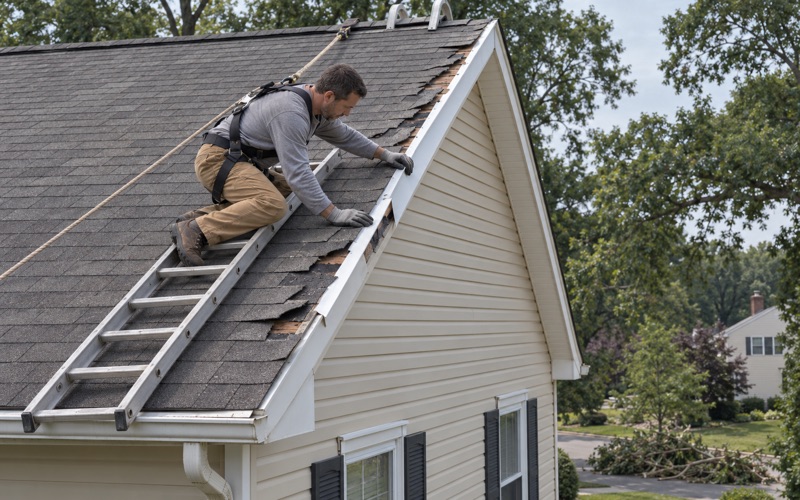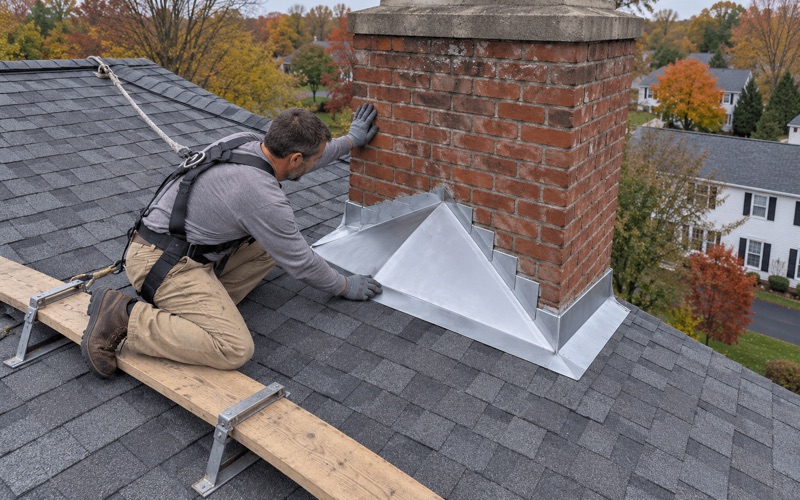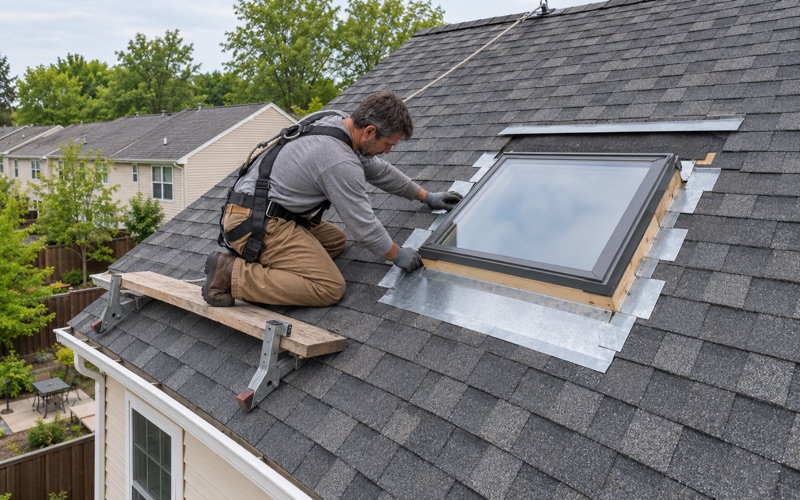
Bensalem Quality Roofing has handled roofing in Hatfield Township for homeowners who want a clear read on their roof after a storm, and we bring more than 20 years of residential work to every inspection. Most calls we take here start with something small that looks wrong from the driveway: a strip of siding hanging loose, a gutter pulled off its hangers, or a dark stain on a bedroom ceiling. Our job is to find out what that small thing means for the roof above it.
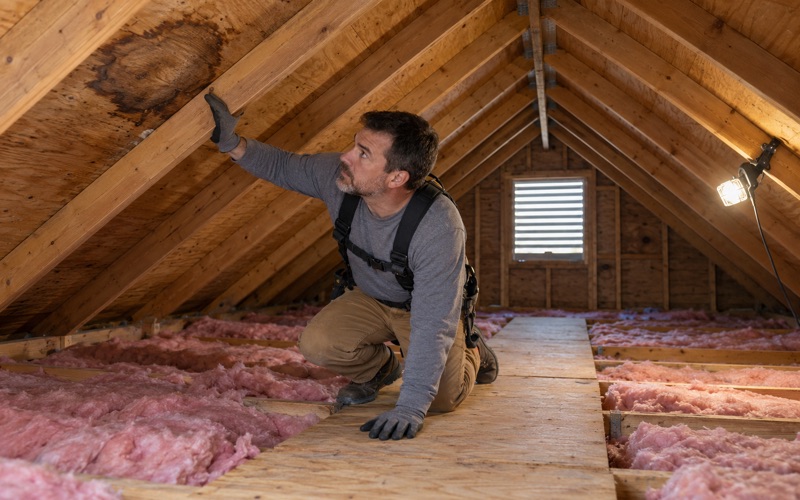
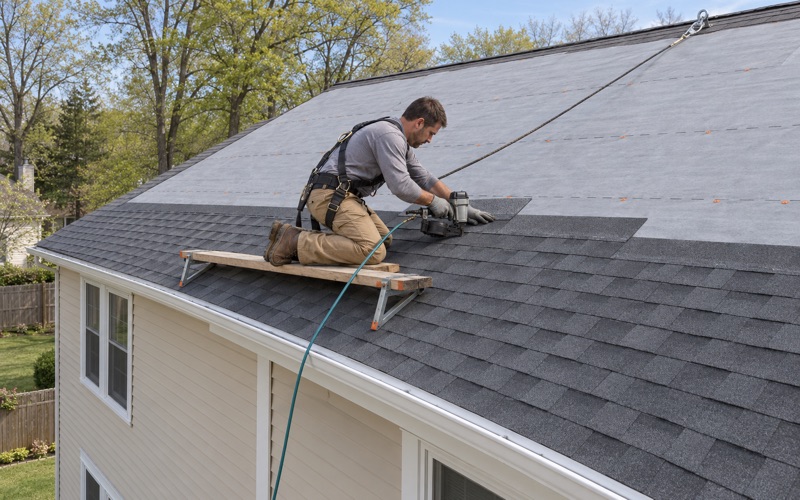
We start every leak call in two places, on the roof and up in the attic, because water rarely shows up inside where it actually gets in. Once the source is traced, you get a plain answer on whether the roof can be repaired before anyone talks about replacing it. If replacement does make sense, the written scope lists tear-off, decking, underlayment, flashing, ventilation and gutters as separate lines so you can hold it up against any other estimate.
This page covers one specific situation that Hatfield households have already lived through: wind damage that arrives in the dark and gets discovered at dawn. Below we walk through what the National Weather Service recorded locally, what torn siding tells us about the roof edge, how we run a morning-after inspection, and what to do about limbs and gutters once the wind has passed.
August 19, 2021: a tornado forms in Hatfield Township
The night of August 19, 2021 is the clearest local example of why a wind event deserves a careful look even when nothing seems badly broken. The remnants of Tropical Depression Fred were crossing the area, and the National Weather Service office in Mount Holly later confirmed tornadoes across Montgomery, Bucks and Berks counties. One of them began inside Hatfield Township.
Where it started and how far it ran
According to the National Weather Service survey, an EF-1 tornado formed at 12:25 a.m. about a mile and a half south of Souderton. Its path ran 8.77 miles into Hilltown Township in Bucks County, with a maximum width of 140 yards.
The survey put the estimated peak wind at 105 mph, and that figure describes the strongest point along the whole path, not a reading taken inside the township. Local news coverage described a track nearly nine miles long and reported no injuries. Because it formed after midnight, the damage showed up at first light.
What the survey found on Garrison Lane
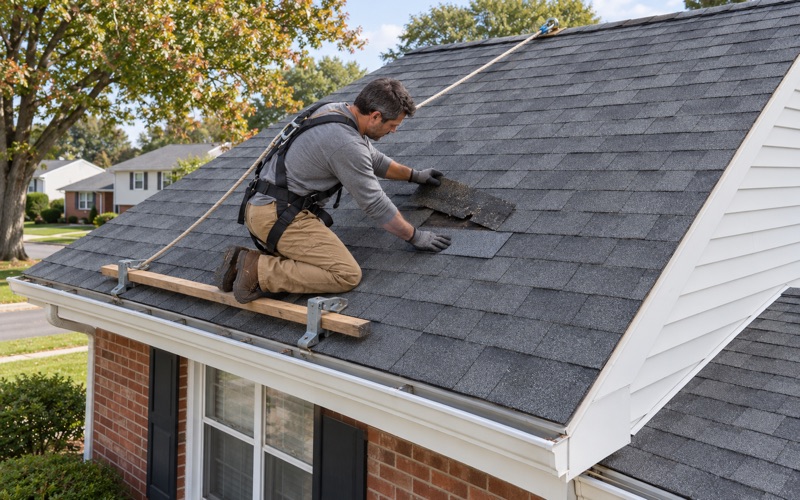
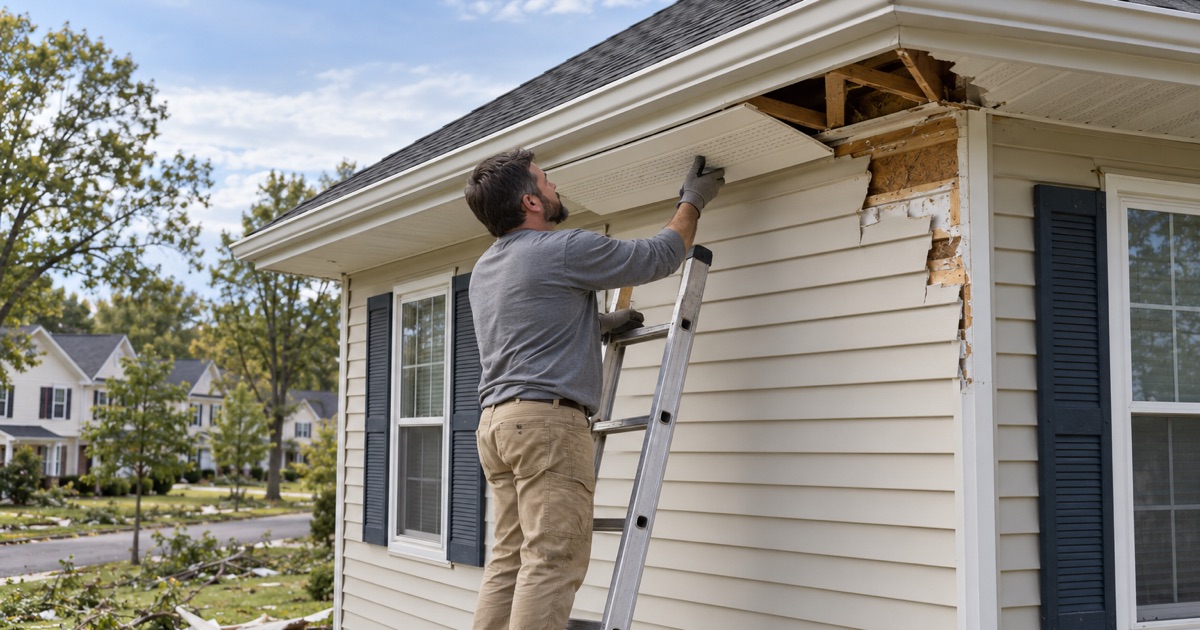
The first damage the survey describes is on Garrison Lane, where the tornado brought down a tree branch and tore siding off a residence. That detail matters more than it might seem. Siding is fastened to the same wall that the lowest edge of the roof and its flashing tie into, so a wall that lost siding has had its roofline tested too.
The survey does not record roof damage at that house, and we never assume there was any. What we do assume is that the edge above a stripped wall needs to be looked at closely rather than from the curb.
Township Line Road and the rest of the track
After Garrison Lane the tornado briefly lifted, then came back down and dropped small trees and branches along Township Line Road. The roof damage the survey records came farther along the path, outside Hatfield Township, before the tornado ended in Hilltown Township about 15 minutes after it began.
For a homeowner near that corridor, the lesson is that limbs and debris on a lawn are a reason to check the roof, not proof that it came through fine. Wind that can bring down small trees can also lift shingle tabs and loosen flashing without leaving anything obvious on the ground.
Looking for roofing closer to Lower Southampton? See Roofing in Lower Southampton.
Siding torn off a wall: checking the roof edge above it
When we arrive at a house where siding has been pulled loose, we start at the wall and work up. The siding, the trim and the roof edge are built as one connected system, and wind that gets behind one layer often finds its way under the next.
Drip edge at the eaves and rakes
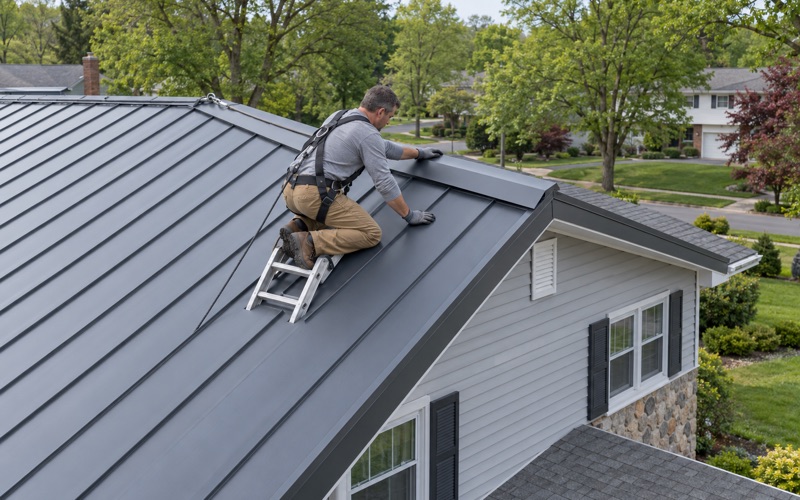
Drip edge is the bent metal strip that runs along the eaves and rakes, carrying water off the roof and away from the fascia. It sits under the underlayment at the eave and over it at the rake, and a strong gust can bend it upward or pull nails loose without tearing anything off.
A bent or lifted drip edge lets water run behind the gutter and soak the fascia board. We check it along the full length of any wall that lost siding, and where it is damaged we replace it rather than hammering it flat, since a flattened strip rarely sits tight again.
Step, apron and kick-out flashing along the wall
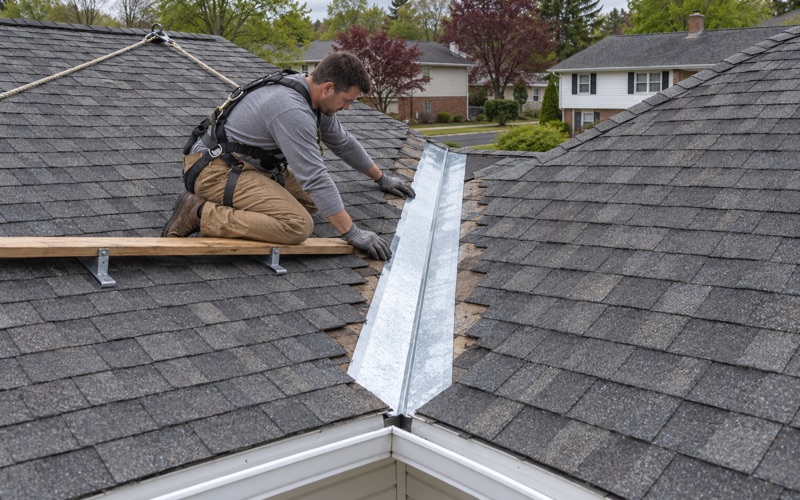
Wherever a roof meets a side wall, such as over a porch, a garage or a one-story addition, step flashing is woven into the shingle courses and tucked behind the siding. When the siding comes off, those flashing pieces are often exposed, bent or pulled away from the wall.
The kick-out flashing at the bottom of that wall is the piece that turns water into the gutter instead of down the siding. Where a lower roof meets a wall head-on, apron flashing seals that joint across its full width. When any of this needs work, we replace step, apron, counter and kick-out flashing with new metal rather than reusing the bent pieces, because a reused flashing is usually the first thing to leak again.
Fascia, soffit and the first shingle course
Below the drip edge, the fascia and soffit can be loosened by the same wind that took the siding. A gap at the soffit lets wind push rain into the eave, and on many homes that soffit also serves as the intake for the attic ventilation.
On top, we lift the first few shingle courses gently by hand to check whether the seal strips have let go. A tab that has unsealed may lie flat again on a calm morning and still lift in the next storm, so we test it instead of judging it by eye.
Overnight storms and the morning-after inspection
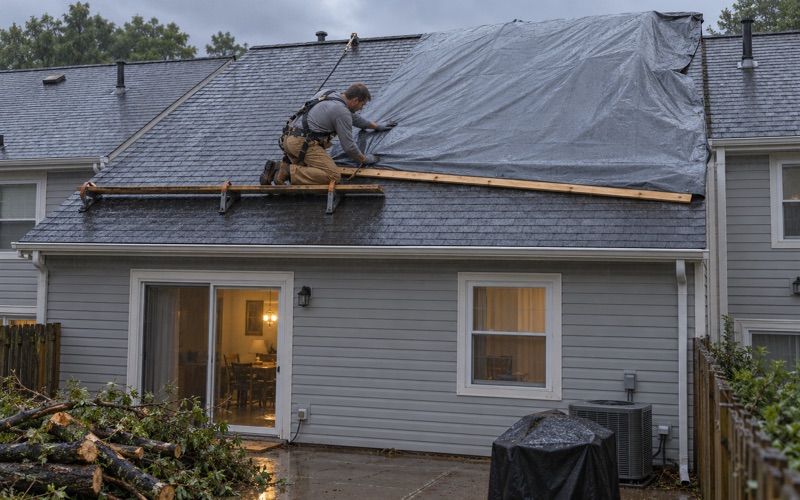
A storm that hits after midnight changes how damage is found. Nobody hears the gutter pull loose or sees the branch hit the roof, so the first look happens at first light, usually from the yard and usually in a hurry before work.
What to check from the ground at first light
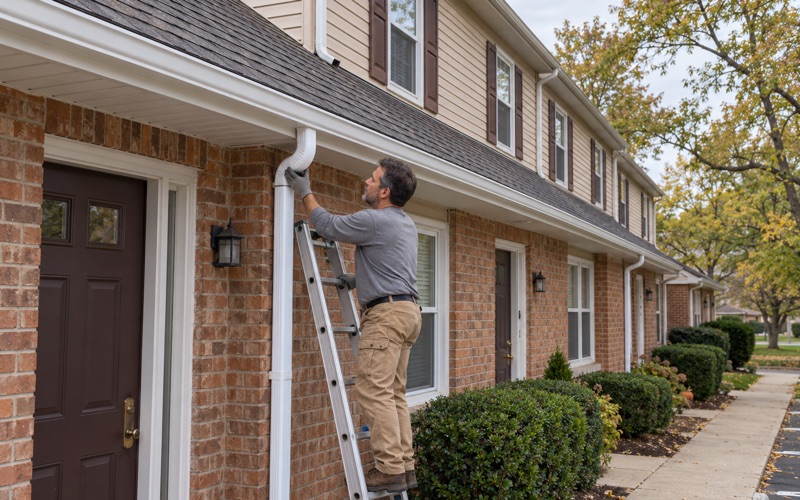
Start with what you can see safely without a ladder. Walk the house and look for missing or out-of-line shingles, metal edges that look bent, gutters sagging away from the fascia, and granules or shingle pieces in the downspout splash areas.
Take photos with the time showing before anything is moved or cleaned up. Then keep off the roof; a wet surface after a wind event is slippery, and loose debris can hide soft spots. If water is coming in, a bucket and a towel inside will hold until we can get there.
Why we go into the attic as well
The roof surface tells us only half the story after a wind event. Inside the attic we look for daylight at the eaves, wet sheathing, damp insulation and water stains running along rafters, which can point to a lifted section that looks fine from outside.
Tracing the water this way is what lets us give a straight answer. A loosened flashing at one wall is a repair, and we will say so. Wider damage across the decking is a different conversation, and if old decking turns out to be damaged once shingles come off, we photograph it and show you before replacing it at the per-sheet price written into the contract.
Photos and a written report for your claim
After an overnight storm we photograph every damaged area and write it up so you have documentation for your own insurance claim. If you ask, our crew will meet the adjuster at the house and walk the roof with them.
We do not negotiate the claim on your behalf. The report is there so the adjuster sees the same drip edge, flashing and shingle damage we did, described in plain terms that match the photos.
Limbs, small trees and gutters after a wind event
The damage along Township Line Road that night was small trees and branches. That kind of debris still does real harm when it lands on a roof or drags across a gutter line.
Branches on the roof
A branch resting on shingles can scrape away granules, crack tabs or punch through at a weak spot, and pulling it off carelessly can do more damage than the fall. We remove limbs from the roof by lifting them clear rather than sliding them down the slope.
Once the branch is gone we check the spot it landed on and the area around it for bruised shingles and nail pops. Small repairs are often all that is needed, and we tell you that before any larger option is raised.
Gutters, hangers and downspouts
Gutters take a lot of the punishment in a wind event, from falling limbs and from wind catching the open trough. A gutter that has pulled loose from its hangers may still look attached while it pitches the wrong way and spills water against the foundation.
We check pitch, hangers and downspout connections along every run. When a gutter needs to be replaced, we size and pitch it together with the roof edge and drip edge, so the water coming off the shingles actually lands in the trough and leaves the house where it should.
Permits and paperwork for storm repairs
Hatfield Township Safety and Code Enforcement requires an Exterior Structure permit for replacement, renovation or alteration of roofs and siding, and its application includes a choice for emergency roof work. Rules differ from one municipality to the next, so we confirm the requirement for your property before pricing the job.
Every Pennsylvania contract we write follows the state home improvement law, including the three-business-day cancellation notice and deposits kept within the legal limit. At the end of each work day we clean the driveway, yard and gutters and run a magnet sweep for roofing nails.
- 20+ Years Experience
- Attic Checked on Every Leak
- Itemized Written Scopes