
Bensalem Quality Roofing handles flat roof repair in Bensalem, PA, serving surrounding cities including Lower Southampton, Delran, Upper Southampton, Bristol Township and Cinnaminson. Flat and low-slope roofs need different materials and different thinking from shingle roofs, and in 20+ years of repairing them we have found that most leaks start at the edges and wall joints rather than in the middle of the membrane.
The flat roofs we repair most often sit over rear additions, enclosed porches, attached garages and small commercial buildings. They are easy to forget until water shows up on a ceiling. By then, the cause is often a detail at the edge that has been letting water in for some time.
We find the cause, repair it with material compatible with the existing roof, and tell you honestly whether the rest of the membrane has years left or is nearing the end. A straight answer about repair comes before any talk of replacement.
Flat Roof Materials We Repair
EPDM Rubber Roofs
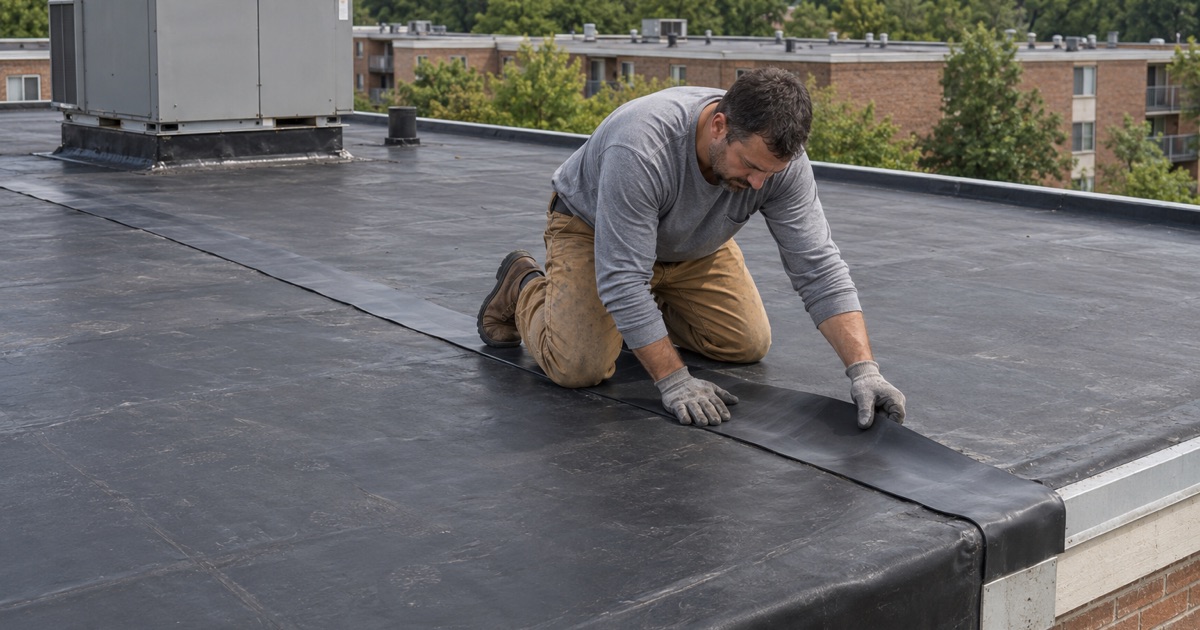
EPDM is a synthetic rubber membrane laid in large sheets and glued or fastened to the deck. It is durable and flexible but can shrink with age, pulling away from edges and walls. Seams that were glued rather than taped are common leak points on older EPDM roofs.
We repair EPDM by cleaning and priming the area and applying a compatible patch or seam tape. Shrinkage at the edges is corrected by reworking the edge detail. Using a product meant for another membrane on EPDM will not bond properly.
TPO and PVC Single-Ply Roofs
TPO and PVC are light-colored single-ply membranes with seams that are heat-welded together. A heat-welded seam is very strong when it is done right, but a poorly welded seam can open over time. Punctures from dropped tools and foot traffic are another common problem.
We repair TPO and PVC by heat-welding new membrane over the damaged area. Seams are probed to find any that did not bond fully. The repair becomes part of the original membrane rather than a patch sitting on top.
Torch-Down Modified Bitumen
Torch-down SBS and APP modified bitumen roofs are built from layered sheets with a granulated cap. Over time the granules wear away, the surface cracks, and blisters form where moisture is trapped. Seams and laps can also lift.
Repairs involve cutting out blisters, torching new cap sheet over damaged areas, and resealing laps. Where torching is unsafe near a wall or wood edge, self-adhered material is used instead. We match the repair to the existing system.
Where Flat Roofs Fail
Wall Tie-Ins and Counter Flashing
Where a flat roof meets the house wall, the membrane must turn up the wall and be covered by counter flashing set into a reglet or tucked behind the siding. When that flashing is missing or simply caulked to the wall, water runs behind the membrane. This is the leak we repair most often on residential flat roofs.
The fix is to rebuild the joint properly, with the membrane carried up the wall and new metal counter flashing protecting the top edge. Caulk alone dries and cracks within a few seasons. New metal set into the wall lasts.
Roof Edges, Drip Edge and Gutters
The edge where water leaves a flat roof needs metal edging that directs water into a gutter or off the building. Loose or missing edge metal lets wind get under the membrane and water run into the fascia. We replace edge metal and reattach the membrane where it has lifted.
Gutters along a flat roof edge must be set low enough to catch water without blocking it. A gutter set too high creates a dam that holds water on the roof. We correct the height when we repair the edge.
Ponding Water and Blisters
Water that stays on a flat roof for days speeds up wear on the membrane and adds weight to the structure. Ponding usually means the roof has sagged or was built without enough slope. Blisters appear where moisture is trapped between layers.
We repair blisters by cutting them out and patching the opening. Persistent ponding is corrected with tapered insulation or a small cricket to push water toward the drain or edge. We price the drainage correction separately so you can decide when to do it.
Flat Roofs on Bensalem Houses
Rear Additions and Enclosed Porches
Many houses in the area have a nearly flat roof over a rear addition or an enclosed porch. These roofs are often small and tie into the main house at a wall. The wall joint is the first thing we check.
Attached Garages
Attached garage roofs often have a large flat area with a long wall joint and a single edge where water drains. Their size means a small defect can let in a lot of water. We inspect the whole surface and the drainage path before deciding on a repair.
Manufactured Home Roofs
Manufactured homes built to the HUD code under 24 CFR 3280 have low-slope roofs with their own construction details. Repairs have to suit that structure, and a full replacement usually means a roof-over system. We quote manufactured home roofs as their own kind of job.
Repair, Recover or Replace a Flat Roof
When a Patch Is Enough
If the membrane is sound and the problem is a single seam, puncture or flashing, a patch is the right answer. We make the repair, check the rest of the roof and tell you what we saw. Most small flat roofs can be kept going this way for years.
When to Recover or Replace
When the membrane is cracked or shrinking across the surface, or the insulation underneath is wet over large areas, a full replacement is more economical than chasing leaks. The residential code limits roofs to two layers, so a roof that already has two must be removed before a new system goes on. A new flat roof is also the time to add tapered insulation for drainage.
- 20+ Years Experience
- Attic Checked on Every Leak
- Itemized Written Scopes