Bensalem Quality Roofing handles roofing in Delran with more than 20 years in business behind every estimate, and a good share of the work in this township involves buildings that hold three or more homes under one roof. Those buildings answer to a different set of New Jersey rules than a detached house does, and those rules name the roof directly.
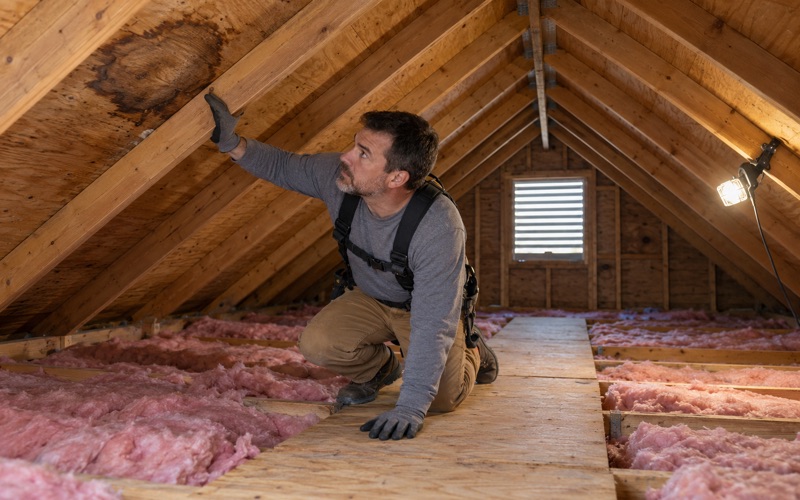
That changes how we approach a call. A stain on a top-floor ceiling is traced from the attic as well as from the roof surface, so the water is followed to where it actually gets in before anything is priced. The owner then gets a straight answer on whether the roof can be repaired, and replacement is discussed only if a repair will not hold.
Because the building sits on the New Jersey side of the Delaware, the job is written to New Jersey’s rules for permits, contracts and sales tax, not Pennsylvania’s. Each municipality also sets its own re-roof rules, so we confirm what applies in Delran Township to that specific building before we put a price on it.
Delran’s Apartment and Condominium Buildings by the Numbers
How the 1,889 units break down
The Census Bureau’s 2024 five-year American Community Survey counts 7,061 housing units in Delran Township, and 1,889 of them, or 26.8%, sit within structures of three or more units. That is about a quarter of the township’s homes. The largest group is the smallest building type: 658 units are in three- and four-unit buildings, while 547 sit within buildings of 10 to 19 units and 434 within buildings of five to nine.
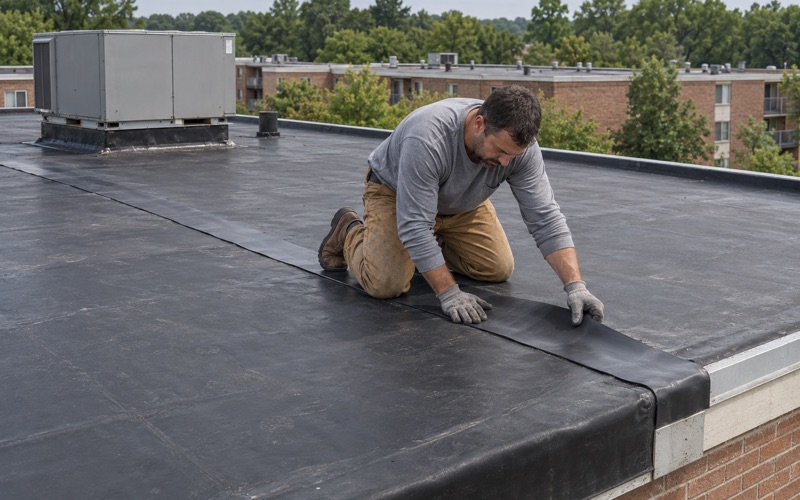
The larger end is thinner: 171 units are in buildings of 20 to 49 units and 79 are in buildings of 50 or more. For roofing, that mix matters more than the total. A three- or four-unit building often carries a pitched shingle roof much like a large house, while the bigger structures are where low-slope membranes, internal drains and long runs of leaders come into play.
Renters, owners and who answers for the roof
Of the households living in those buildings, 1,450 rent and 306 own, according to the same survey’s tenure tables. A renter rarely decides anything about the roof; the building owner does, and under New Jersey law that owner carries specific duties for it. For the owner households, the answer depends on how the building is organized, which is why we ask who holds the roof before we price it.
Where several units share one roof, we plan the job around the neighbors as well as the paying owner. A tear-off over one section of a shared roof has to tie cleanly into the sections left alone. The walls between units get the same attention we give townhouse and twin roofs everywhere we work, so the seam between old and new work does not become the next leak.
Older rental communities and condominium buildings
Delran’s multi-unit housing is not all new. Tenby Chase began with an apartment complex when the planned community was laid out, and Tenby Chase Apartments is listed as a 327-unit complex built during 1975 and renovated during 2001. Hunters Glen sits at 3001 Route 130, though we have not found its unit count or the year it was built.
Condominium buildings deserve a separate word. A condominium building may hold an exemption from the state’s inspection program, so we never assume a given Delran condominium is inspected by the state. What we do check is who is responsible for the roof under the association’s documents, because that decides who signs the contract and who receives the written scope.
Looking for roofing closer to Upper Southampton? See Upper Southampton Roofing.
What New Jersey’s Multiple-Dwelling Code Asks of a Roof
New Jersey’s Hotel and Multiple Dwelling Law places every building of three or more dwelling units under the state Bureau of Housing Inspection. The maintenance regulations that go with it, Chapter 5:10 of the New Jersey Administrative Code, name the roof directly rather than leaving it to a general clause. Two sections carry most of the weight for roofing work on these buildings.
Keeping water out of roofs and skylights
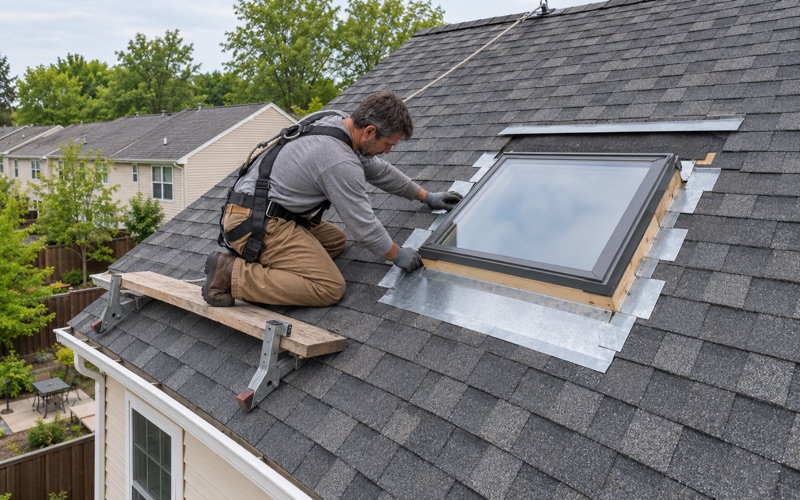
Section 5:10-7.4, which deals with leakage, drafts and infestation, requires exterior walls, roofs, windows, doors, skylights and foundations to be maintained so as to keep water from entering. That covers the field of the roof, and it also reaches the skylights and penetrations that sit above top-floor units. On a multi-unit building, the leak a tenant reports can trace back to one of those openings rather than to worn shingles.
Skylights and penetrations are also where water hides best. On a multi-unit building it can travel along a rafter or a membrane seam and appear two units away from where it enters, which is why the attic or ceiling space gets checked on every call. We trace it to the entry point first, then price the fix that addresses it.
Worn material repaired or replaced
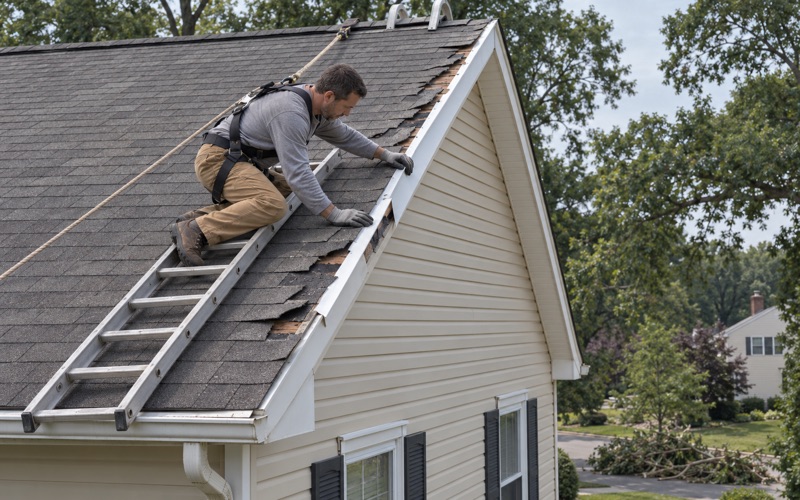
The same section requires damaged or badly worn material to be repaired or replaced. It does not say replace the whole roof, and we read it the same way. A building with a few failed flashings or a tired skylight may need targeted repair, and we tell the owner plainly whether a repair will hold before replacement comes up at all.
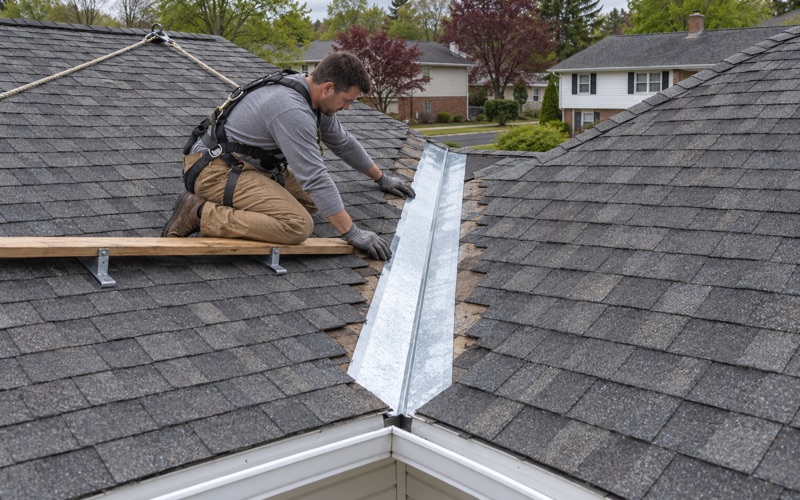
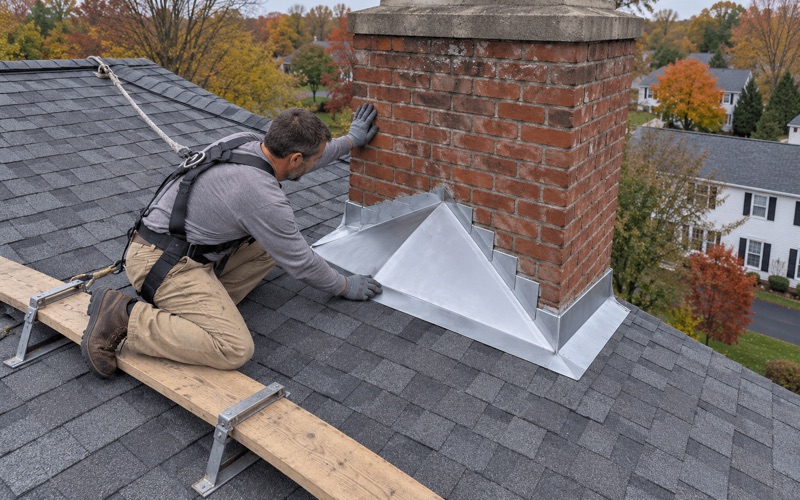
When replacement is the honest answer, step, counter and chimney flashing is replaced with the roof rather than reused under new material. Skylights get new flashing matched to the unit, such as a Velux flashing kit on a Velux skylight. Reusing a tired flashing is a false saving on any building, because that joint is often the first place water returns.
Outside the one- and two-family maintenance rule
New Jersey treats re-roofing a detached one- or two-family house as ordinary maintenance. A building of three or more units falls outside that item, so its re-roof is handled as construction-permit work. For an owner, that means the re-roof schedule should allow for it from the first estimate, not after the old roof is off.
Leaders, Drainpipes and the Five-Year State Inspection
Leaders fastened, tight and draining away
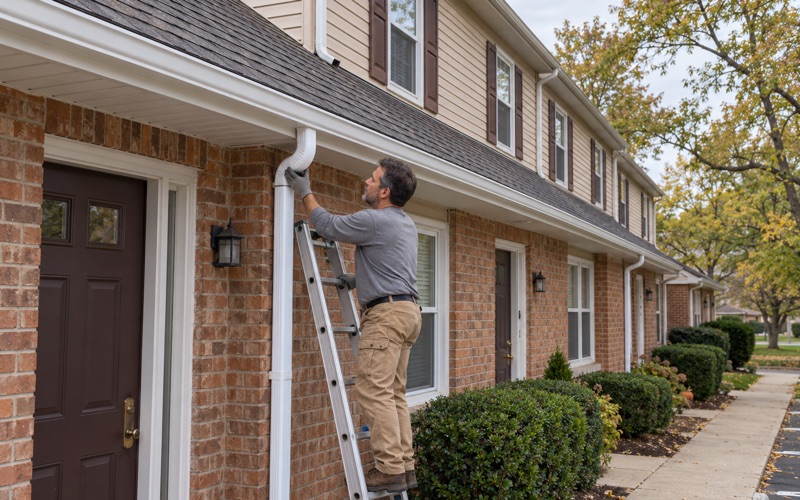
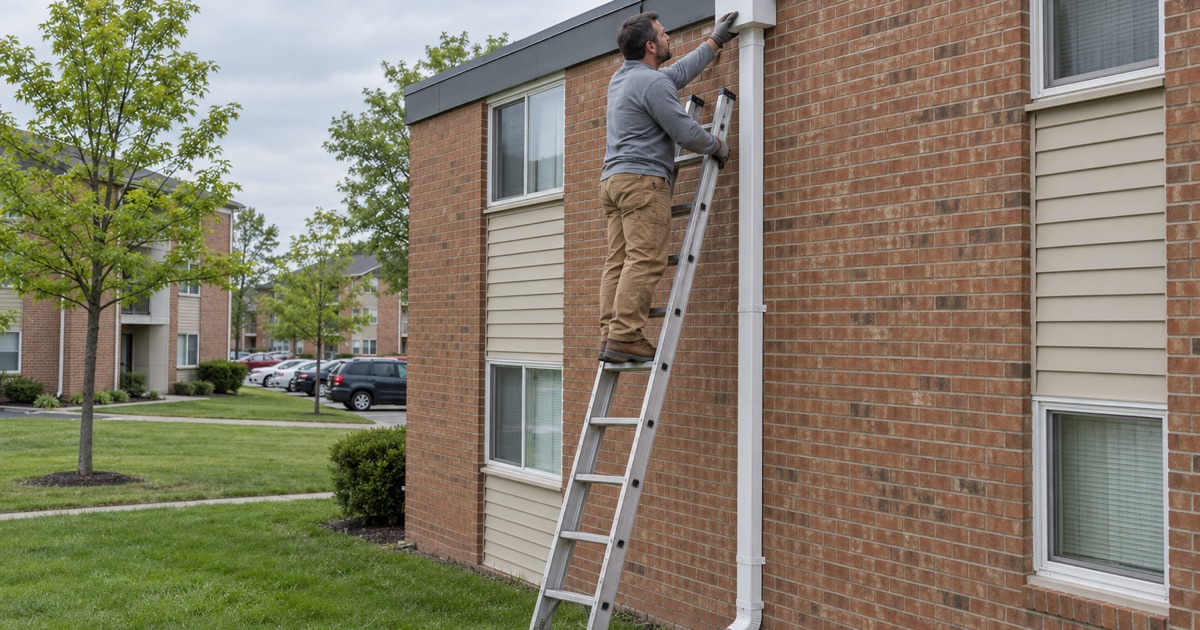
Section 5:10-7.5 deals with leaders, the term the code uses for downspouts and drainpipes. They must be fastened to the building, kept free of leaks and obstructions, and discharge storm water away from the foundation walls. On a three-story building the leaders carry water from a large roof area down a long run, so a loose bracket or a clogged elbow shows up quickly as staining or wet ground at the base.
We treat the leaders as part of the roof, not as a separate trade. A new roof that sheds water well into a leader that dumps it against the foundation has not finished the job the code describes. Where a leader empties onto a walkway or into a planting bed against the wall, we extend or redirect it as part of the scope.
Sizing gutters and leaders with the roof
Gutters and downspouts are sized and pitched with the roof rather than treated as an afterthought. Seamless aluminum gutters avoid the joints that leak along a long eave, and the number of leaders is set by the roof area each one drains. On apartment buildings with long, unbroken eaves, too few leaders is a common reason gutters overflow during a heavy rain.
Drip edge at the eaves and rakes, and kick-out flashing where a roof edge meets a wall, keep water headed for the gutter instead of behind it. These are small parts. On a building whose maintenance code calls out water entry by name, they are where a scope either holds up or does not, so each one is written into the estimate.
Registration, annual recertification and the five-year cycle
Owners of buildings of three or more dwelling units register them with the Bureau of Housing Inspection and recertify their registration information every year. State law also requires a five-year cyclical inspection of these properties. Roofs and leaders are part of what the maintenance regulations cover, so an owner with an inspection ahead has good reason to know their condition beforehand.
We have not read any inspection result for a Delran building, and we do not predict one. What we can do is document the roof as it stands. Our written scopes list tear-off, decking, underlayment, flashing, ventilation and gutters as separate lines, which gives an owner a clear record of what was found and what was done, and lets two estimates be compared item by item.
Alina Apartments and the New Buildings on Route 130 South
What the Planning Board heard
Delran’s newest multiple dwellings are planned on Route 130 South. At its February 6, 2020 meeting, the Delran Planning Board heard an application from Delran Associates, LLC for Block 65, Lot 18.01: a 240-unit multi-family development across 10 buildings of 24 units each, three floors apiece, with 192 market-rate units and 48 fair-share units.
The minutes describe each building at roughly 8,000 to 9,000 square feet of footprint, on a 14.6-acre tract left from the Home Depot site developed during 2000/2001, to be built over two phases. The applicant told the board the property would not be managed by an HOA; the owner manages it. Weiss Properties was among the applicant’s professionals.
The construction loan and what is still unknown
During November 2025, Weiss Properties and Amboy Bank closed a $50 million construction loan for the project, now called Alina Apartments, on a long-vacant site along Route 130. That is as far as the record we have goes. We do not know the project’s construction status, its completion date or what kind of roof the buildings will carry, and we will not guess.
What the plan does tell us is the shape of the work ahead. Ten three-story buildings under one owner means one party answering for a large combined roof area and many leaders. All of it falls under the same multiple-dwelling rules as every older building of three or more units in the township.
How we plan roof work on a Delran multi-unit building
On older three- and four-unit buildings and larger complexes alike, damaged decking found once the old roof is off is photographed and shown to the owner before it is replaced, at a per-sheet price set in the contract. That keeps a surprise from becoming a dispute, and it gives the owner photos to keep with the building’s records.
The contract itself follows New Jersey practice, including the Form ST-8 capital improvement certificate where the work qualifies. At the end of each work day the driveway, yard and gutters are cleaned and the ground is swept with a magnet for roofing nails. That last step matters on a property where tenants, visitors and children walk past the building every day.
- 20+ Years Experience
- Attic Checked on Every Leak
- Itemized Written Scopes