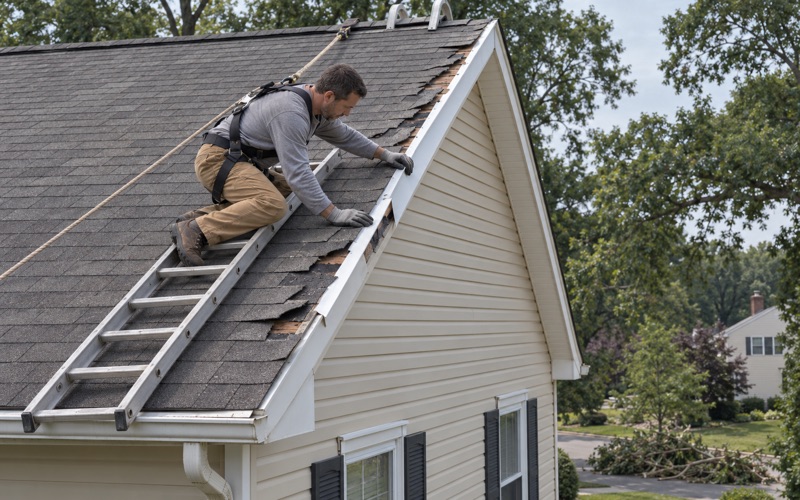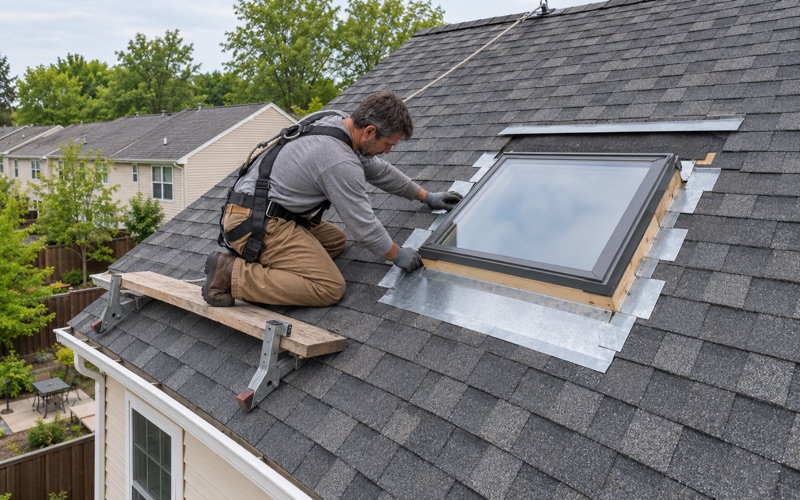
Bensalem Quality Roofing brings more than 20 years in the trade to roofing in Cinnaminson, and the first thing we settle on a re-roof here is not the shingle color but where the old roof will go once it comes off. Planning the container, the crew’s access and the daily cleanup before anything is torn off is what keeps a replacement on schedule and keeps the property in the shape the owner expects.
Not every call ends in a new roof. When a ceiling shows a stain, we go into the attic as well as onto the roof, so the water is traced to the spot where it actually enters before a price is written. Then we give a plain answer on whether the roof can be repaired, and only if it cannot do we talk about replacement.
When replacement is the right call, the written scope breaks tear-off, decking, underlayment, flashing, ventilation and gutters into separate lines, so an owner holding two estimates can compare them item by item. Because we work on both sides of the Delaware, a New Jersey job is written to New Jersey rules rather than carried over from a Pennsylvania contract.
Where the Dumpster Goes on a Cinnaminson Re-Roof
The township’s answer on street placement
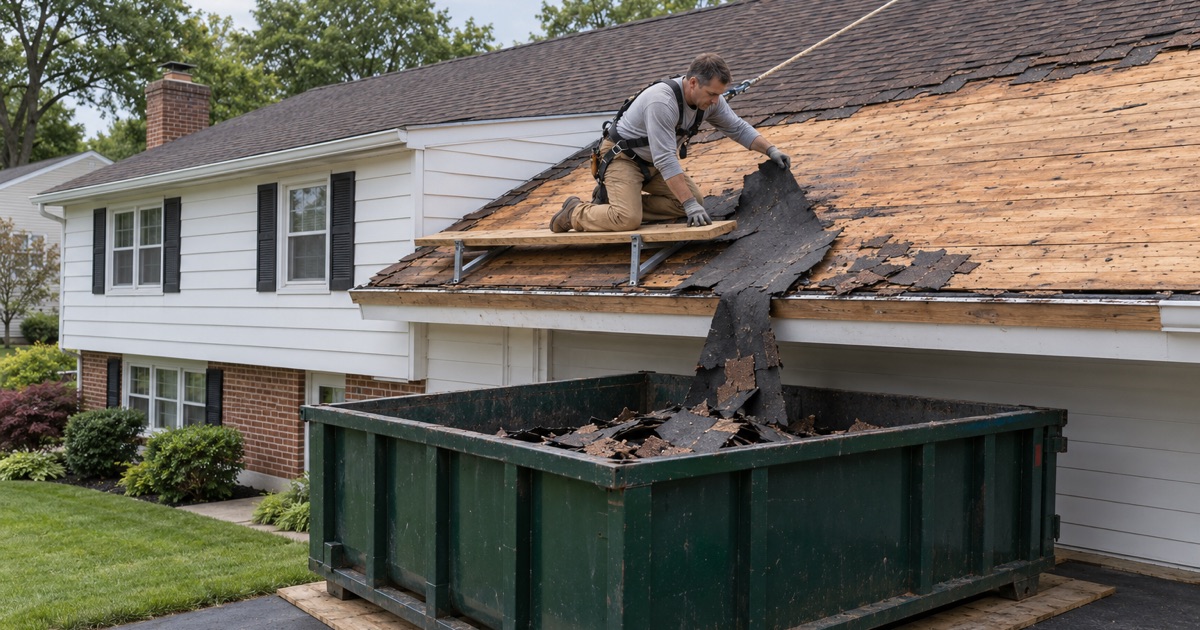
Cinnaminson Township is direct on this point. Its Office of Community and Economic Development answers the question in its FAQ with a flat “NO, dumpsters are NOT permitted to be placed in any street under any circumstances.” There is no curbside option to request and no exception for a short job, so the container for a tear-off has to sit on the property itself.
For most homes that means the driveway. We treat the dumpster location as part of the estimate rather than a delivery-day detail, because a container that cannot be placed where it needs to go changes how the crew loads debris, how many hauls the job takes and how long the driveway is out of use.
Measuring the driveway before the estimate
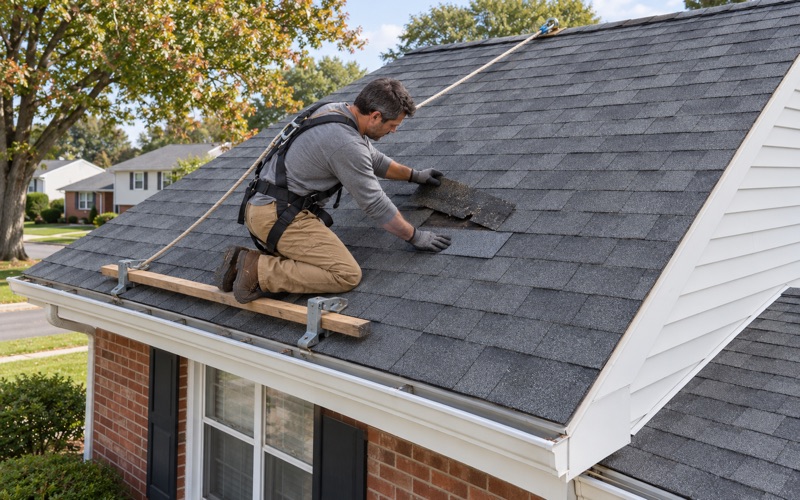
During the estimate visit we look at the driveway the way the hauler will. That means its length and width, the slope toward the street, overhead wires and tree limbs, and how close the container can sit to the eaves where the crew will be dropping old shingles. A short walk from roof edge to container keeps debris off the lawn and the job moving.
The size of the container follows from the roof. A one-layer tear-off on a modest ranch fits a smaller box than a two-layer tear-off on a larger two-story house, and choosing correctly matters more when the driveway is the only place it can go. We size it so the job is not waiting on a mid-week swap that blocks the drive a second time.
Keeping the driveway usable and clean
Owners lose the use of their driveway for the days the container is there, so we plan around it. Cars get moved to a spot that does not trap them behind the box, deliveries of shingles and underlayment are timed so they do not compete with it for space, and boards go down under the container where the surface needs protecting.
At the end of every work day the crew cleans the driveway, the yard and the gutters, and runs a magnet sweep for roofing nails. On a job where the container shares the driveway with the family’s cars, that daily pass is what keeps a stray nail out of a tire. When the roof is finished, the container leaves and the drive is swept one final time.
Looking for roofing closer to Bristol? See Bristol Roofing.
No Township Inspection When a Cinnaminson House Sells
What the township does and does not require at resale
A municipal resale inspection is easy to assume, but Cinnaminson does not require one. The same township office states that it “does not require CO inspections for resale of a residential home,” and that the inspections it does require come from the Sewerage Authority and the Fire District instead.
Neither of those inspections is a roof inspection. The result is that nobody from the township climbs a ladder or walks an attic when a Cinnaminson house changes hands, and the roof’s condition at resale is whatever a buyer’s own private inspector finds, or fails to find.
Why that matters to a seller
For a seller, that gap cuts both ways. There is no municipal checklist to pass, but there is also no official finding to point to if a buyer’s inspector writes up a soft spot or a stained rafter late in the deal. A roof question raised during the inspection contingency tends to turn into a price conversation on a short clock.
A seller who wants to get ahead of it can have the roof looked at before listing. We give the same straight answer we give any owner: whether the roof needs a repair, whether it has a few good years left, or whether replacement is the honest recommendation. That answer, in writing with photographs, gives a seller something concrete to share instead of guessing.
Why that matters to a buyer
A buyer in Cinnaminson should assume the roof has not been looked at by anyone with authority over the sale. The private home inspector is the only professional who will judge it, and a general inspection is a broad survey rather than a roofing assessment. If the report flags the roof at all, a closer look from a roofer before the contingency runs out is cheap insurance.
We can walk the roof and the attic of a house under contract and explain what the inspector’s notes mean in practical terms. A buyer then knows whether a line in the report is a minor repair, a sign of an older roof near the end of its life, or a reason to ask the seller for a credit.
What a Buyer’s Inspector Should Check on the Roof
The covering and its age
Most of Cinnaminson’s housing is detached. The census counts 4,728 of the township’s 6,320 units as single detached homes, and 3,150 of all units were built from 1950 through 1969, so an older house may have been re-covered more than once. An inspector should note the shingle type, visible wear such as granule loss and curled tabs, and whether there is any sign of more than one layer.
Layer count matters because the residential code limits how many coverings a roof can carry. A house that already has two layers cannot simply take a third, and a buyer budgeting for replacement should know that the next roof will be a full tear-off, with the larger container and the extra labor that comes with it.
Flashing at chimneys, walls and valleys
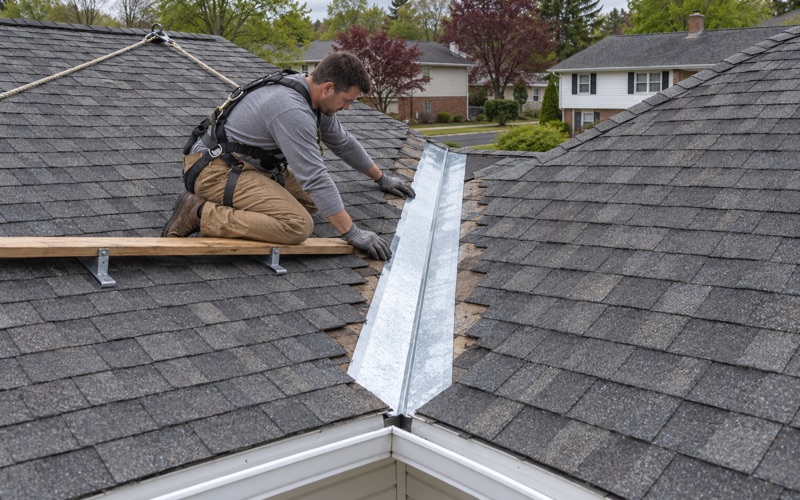
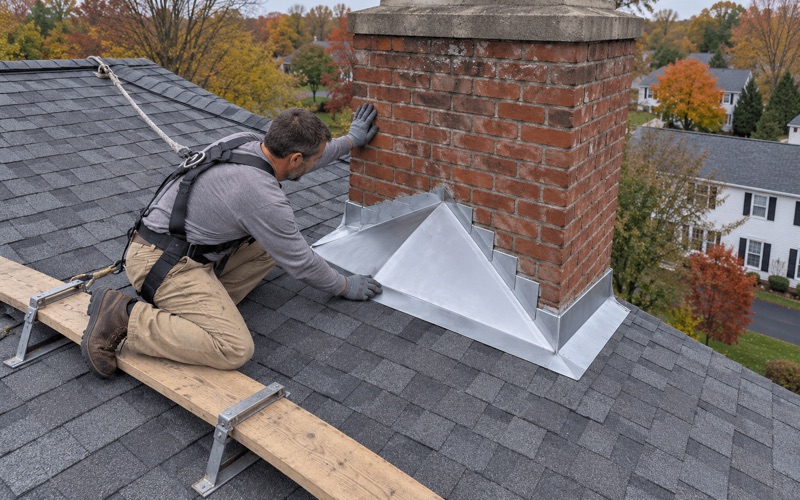
The places where a roof meets something else tend to leak first. Chimney flashing, step flashing along a sidewall, counter flashing set into a reglet, and the valleys where two slopes meet all deserve a close look, along with pipe boots, which tend to crack before the shingles around them wear out.
When we replace a roof, step, counter and chimney flashing is replaced with it rather than reused under new material. A buyer whose report mentions old or patched flashing should know that it is part of our replacement scope, and a sealant-patched chimney is a common source of the ceiling stain an inspector finds below it.
The attic side of the roof
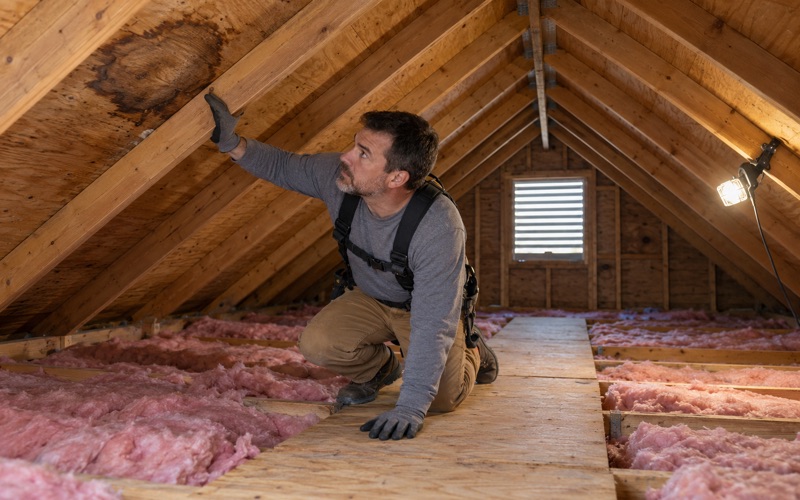
Much of what a roof is doing shows up underneath it. Dark staining on the underside of the decking, rusted nail tips, damp insulation and daylight around a pipe all point to water or condensation problems that are invisible from the yard. Ventilation is part of the same picture, since a roof with little intake at the soffits and nowhere for air to leave can build up moisture over a winter.
This is the same attic check we make on every leak call, and it is worth asking an inspector whether they went up there. If the hatch was blocked by stored belongings or the inspector only looked from the opening, the roof assessment is incomplete, and it is worth finishing before closing.
Contractor Registration and the Township’s Permit Table
Proof of registration comes first
The township’s community development office states plainly that “Municipal Construction Permits WILL NOT be issued without proof of registration from any contractor working on your home.” Any work on a house that does need a construction permit therefore starts with the contractor showing New Jersey home improvement contractor registration to the township.
That makes registration a reasonable first question for any roofer an owner is considering. Asking for it at the estimate stage, before a deposit changes hands, is easier than discovering later that a permit cannot be pulled under the name on the contract. The requirement covers any contractor working on the home, not only roofers.
What the permit table says about roofs
The township’s own permit table lists a building permit for “Roof” as “Commercial only,” and construction permit fees are set out in Township Code Chapter 265-7. That table is a starting point, not the last word for every property, so we check the rule that applies to the specific house before the job is priced rather than assuming one answer fits the whole township.
Separately from permits, the township enforces property upkeep through its Property Maintenance Code, Chapter 405, administered by a Code Enforcement Officer. A roof left to fail can become a maintenance matter as well as a leak risk, which is one more reason not to let a known problem sit.
What goes into a Cinnaminson contract
New Jersey treats sales tax on a capital improvement differently from a repair, and the Form ST-8 capital improvement certificate is the paperwork that goes with it. We settle that paperwork at signing rather than at the final invoice, alongside the deposit and payment schedule written into the contract.
Decking is the one item no one can see until the old roof is off. When damaged boards turn up, we photograph them and show the owner before replacing anything, at a per-sheet price written into the contract from the start. Combined with the driveway plan and the daily cleanup, that is what an owner in Cinnaminson can expect from the first visit to the final sweep.
- 20+ Years Experience
- Attic Checked on Every Leak
- Itemized Written Scopes