Bensalem Quality Roofing brings more than 20 years of work to roofing in Burlington Township, and much of what owners here ask us starts at the edge of the roof rather than the middle of it. They want to know whether a storm left something behind that cannot be seen from the lawn. We answer that by looking at the eaves, the soffit and the attic together before any number goes on paper.
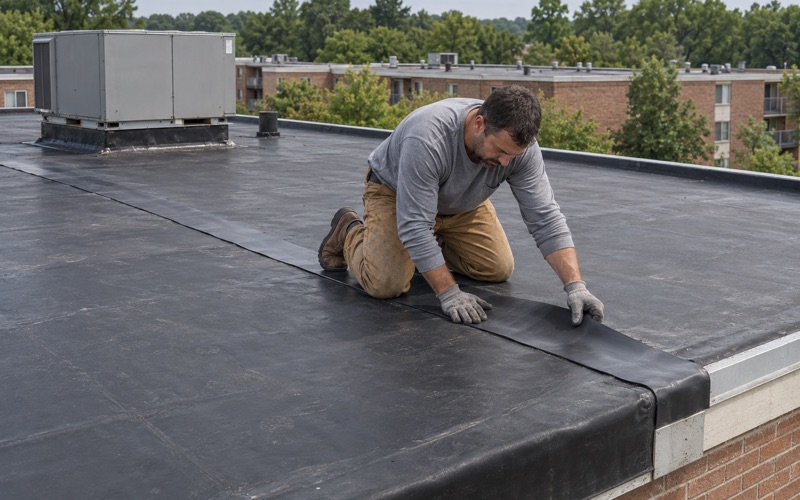
A leak or a loose panel gets the same first step every time: someone goes into the attic as well as onto the roof, so the water is followed to the spot where it actually gets in. Only after that do we say plainly whether the roof can be repaired. Replacement comes up only when a repair would not hold, and the owner hears the reason in plain words.
Because this is a New Jersey house and our crew is based across the river, every estimate is written to New Jersey’s rules on contracts and sales tax rather than Pennsylvania’s. The scope breaks out tear-off, decking, underlayment, flashing, ventilation and gutters as separate lines, which lets a homeowner set our number beside anyone else’s and compare the two item by item.
September 1, 2021: The EF-1 That Started in Burlington Township
Where the path began
On September 1, 2021, the remnants of Ida produced a tornado that the National Weather Service office at Mount Holly later rated EF-1. Its survey placed the touchdown 2 miles southwest of the City of Burlington, and that start point falls inside Burlington Township rather than the city next door. From there the track ran toward the Delaware and across it.
Fox Weather’s preliminary list the next day described the tornado as running from Edgewater Park to Bristol, a confirmed EF-1 with estimated peak winds up to 90 mph. The final survey moved the starting point to 2 miles southwest of Burlington, which geocodes into this township. For an owner documenting damage, citing the final survey rather than the early list keeps the record straight.
How big the storm was
The survey’s numbers are modest next to the tornadoes most people picture: an estimated peak of 90 mph, a path 2.8 miles long, and a maximum width of 200 yards. The whole track took about five minutes, crossing the river and ending in Bristol, Pennsylvania, between 6:59 and 7:04 p.m.
That 90 mph figure is the estimated peak for the whole path, not a reading at every house along it. The damage the survey lists on this side of the river is mostly trees, branches, a window and trim. The roof covering peeled off at the far end belonged to a commercial building near Mill Street in Bristol, not to anything in the township.
Why the date still matters for a roof
A storm that passes in five minutes can leave damage that takes years to show. Water that gets behind a loosened edge does its work slowly, in sheathing, fascia and insulation that nobody looks at. When an owner calls us about a stain or a soft spot near the eaves, asking whether the house sat near the 2021 path is part of tracing where that water started.
Looking for roofing closer to Doylestown Township? See Roofing in Doylestown Township.
Jennifer Lane, Shive Place, Handler Drive and Beverly Road
The National Weather Service survey names the streets where its team found damage, and its account of them is specific. It does not describe a roof covering torn off a house in the township; what it records is trees, limbs, a broken window and soffit damage, and each of those has a roof question attached.
Jennifer Lane
The survey team found numerous hardwood and softwood trees uprooted along Jennifer Lane. Further west on the same street, a pine came down and broke a window of a residence. A tree that heavy landing against a house rarely touches only the glass, so the gutter line, the fascia and the lower shingle courses above a strike like that deserve a close look of their own.
Uprooted trees also matter for what they leave standing. A neighboring tree that lost part of its root hold may lean further over the next few seasons, and limbs that rubbed a roof during the storm can keep scraping granules off the shingles every time the wind picks up. We note those trees on the write-up so the owner can decide about them separately from the roof.
Shive Place and Handler Drive
Where the tornado crossed Shive Place and Handler Drive, the survey records several trees snapped and large branches brought down. It also notes soffit damage to a couple of homes nearby. That is a short sentence in a government report, but on a house it describes the underside of the roof edge, where the overhang meets the wall.
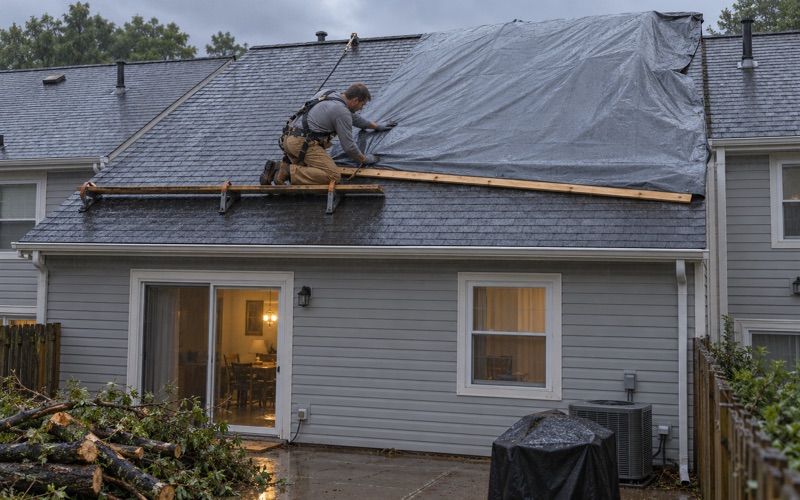
Snapped trunks and large limbs are the more obvious problem, and a branch resting on a roof should come off before anyone judges what is under it. Once the debris is cleared, we walk the slopes, check the ridge and look at every penetration, because a limb that struck once may have bounced and struck again further up the roof.
Beverly Road near Handler Drive
The survey calls the damage along Beverly Road near the intersection with Handler Drive perhaps the most impressive on the whole path. For homes in that stretch, the useful question is not whether the storm hit hard but which part of each roof took the force. Wind strong enough to topple trees usually works first on edges, corners and anything already loose.
That is why our inspection near Beverly Road starts at the perimeter rather than the field of the roof. Rakes, eaves and the corners where two edges meet are where a shingle tab lifts, a drip edge bends or a soffit panel shifts, and those small changes are what let water in later.
Soffit and Eave Damage: What a Ground-Level Look Misses
Why soffit damage goes unnoticed
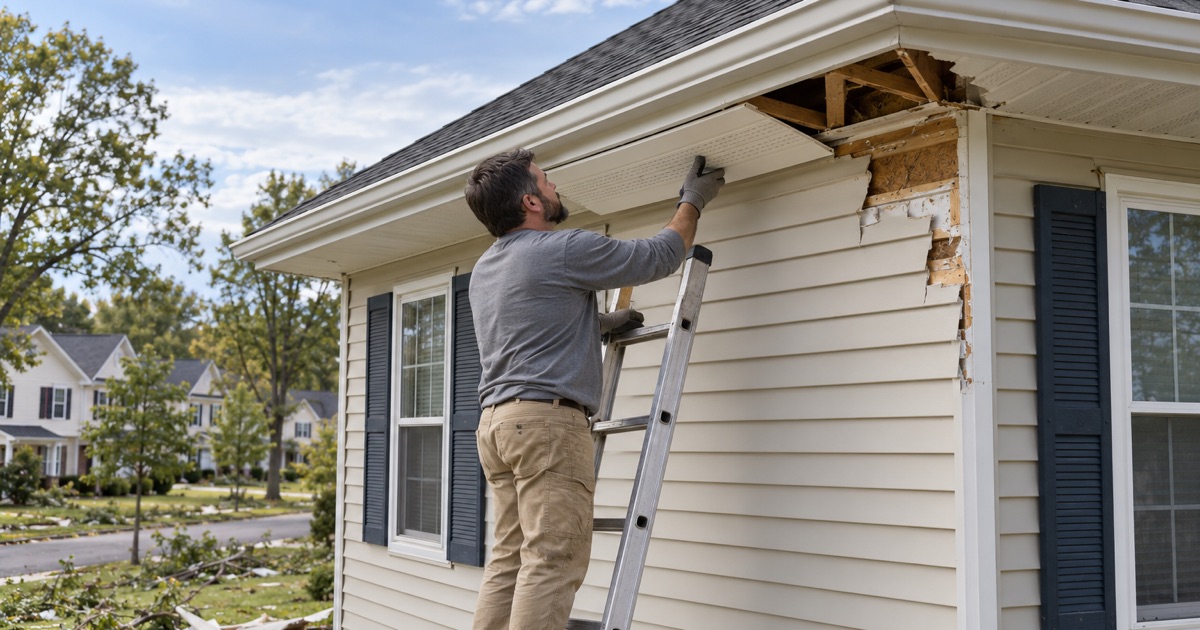
Soffit is the panel that closes the underside of the eave, and from a lawn it sits in shadow most of the day. A cracked vinyl panel, a section pushed up into the eave, or a vent strip knocked loose can look fine from the driveway. Owners often notice it only months later, when a bird nest or a water stain gives it away.
That delay is the real cost. A storm that did nothing worse than shift a soffit panel has still opened the roof edge, and every rain after it is another chance for water to work in where nobody is watching. We would rather find it the week of the storm than during the next one.
How wind-driven rain gets in
Rain driven sideways by strong wind does not fall the way ordinary rain does. It can push up under the drip edge, into a gap between the fascia and the soffit, and into the eave cavity through a damaged vent. That reasoning is our own inference from how roof edges are built, not something the survey measured, but it is why we treat soffit damage as a roof problem.
Once water reaches the eave cavity, it tends to stay there. Fascia boards soften, the bottom edge of the roof decking darkens, and insulation packed against the eaves holds moisture against wood. None of that is visible from outside until paint peels or a gutter starts pulling away from a board that no longer holds a screw.
Ventilation runs through the soffit
On many houses the soffit is also the intake half of the attic ventilation, with a ridge vent at the top drawing air in through vented panels at the eaves. When a storm crushes or blocks those panels, the attic can lose its intake, trapping heat in summer and moisture in winter. Replacing damaged soffit is a chance to confirm the net free area still balances the ridge.
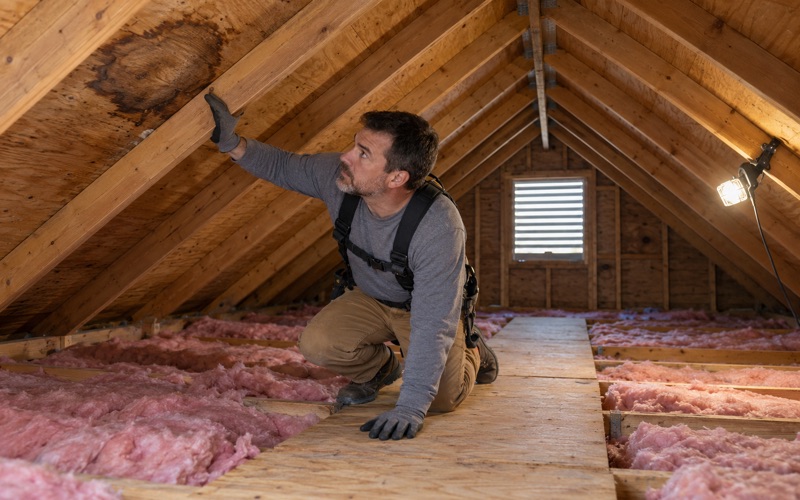
The attic tells us a lot here. Daylight showing where it should not, damp insulation near the eaves, or stained sheathing along the lowest boards are signs that the edge was opened. Because every leak call already includes a trip into the attic, this check is part of the visit rather than an add-on.
Checking a Roof Edge After an EF-1 Storm
What we look at first
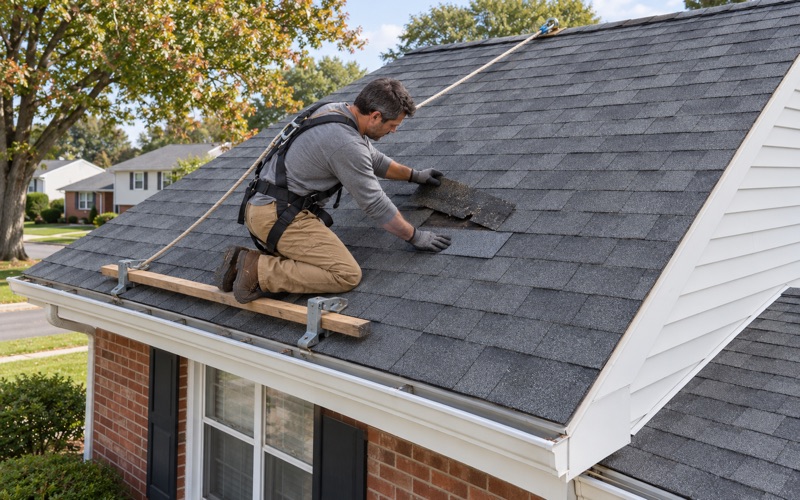
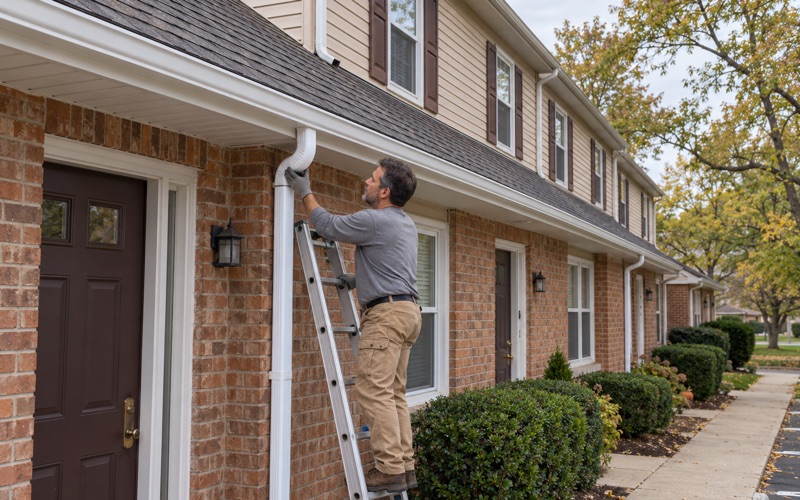
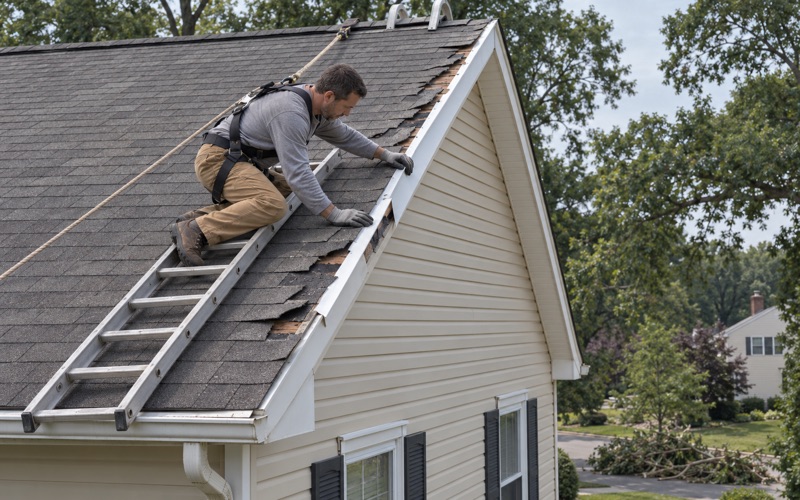
After a storm like the one on September 1, 2021, we start at the edge and work up. That means soffit panels and vents, fascia boards, drip edge at the eaves and rakes, the gutter hangers, and the first few courses of shingles. Lifted tabs near the edge, creased shingles and torn starter strip all show where the wind found a grip.
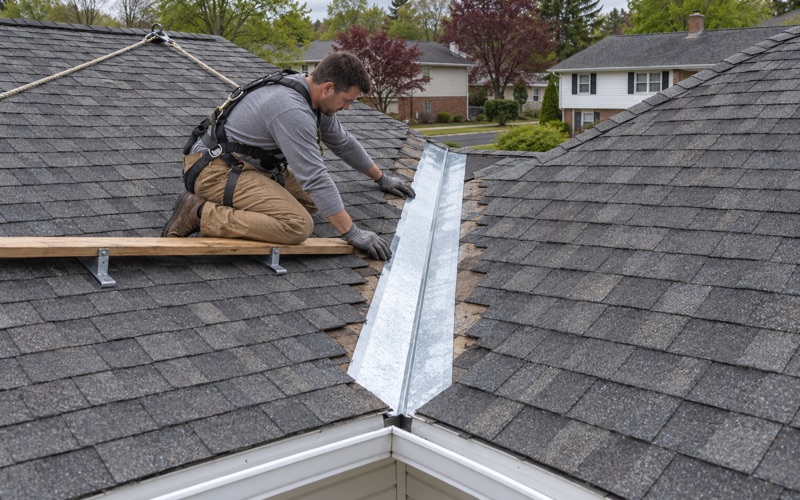
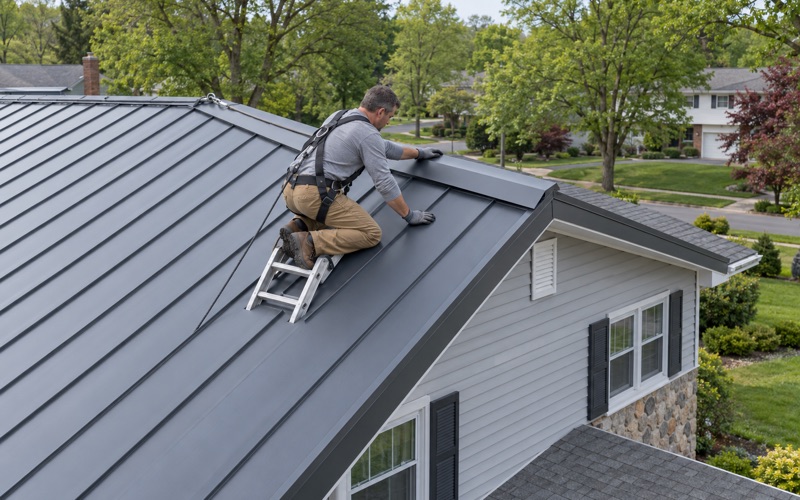
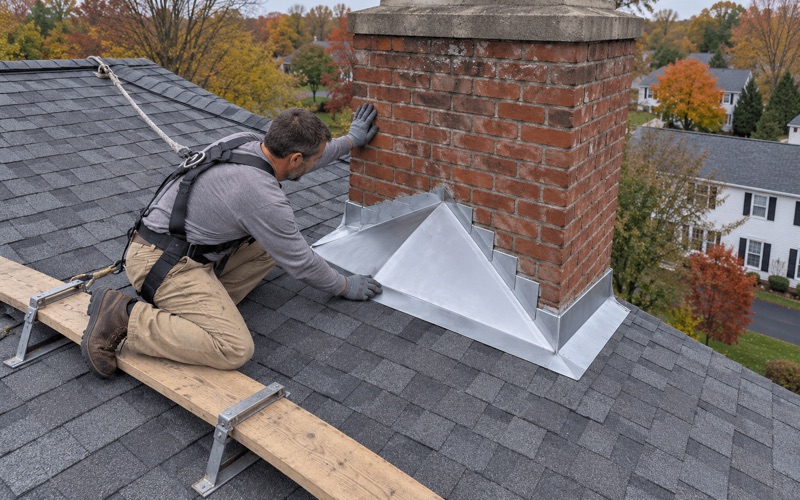
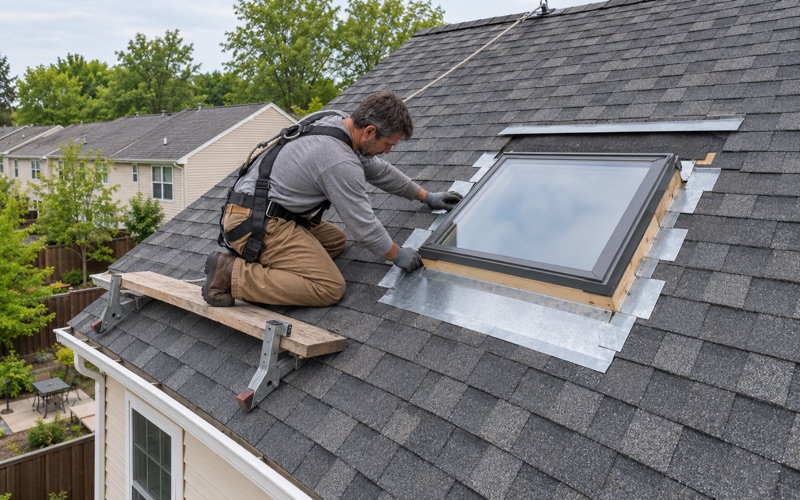
Higher up, we check the ridge cap, step flashing along any wall, and the flashing around chimneys, pipes and skylights. Shingles tested to ASTM D3161 Class F or ASTM D7158 Class H are built to resist wind, but a rating describes the shingle, not a soffit or drip edge that has already been pushed out of place.
Fallen trees, broken windows and the roof above them
Where a tree came down near a house or a window broke, the roof just above it is the next place to look. Gutters bent by a falling limb can tip water back behind the fascia, and a branch that grazed the eave may have cracked the drip edge or punched through the soffit. Those are small repairs when caught early, and rotted fascia and decking when they are not.
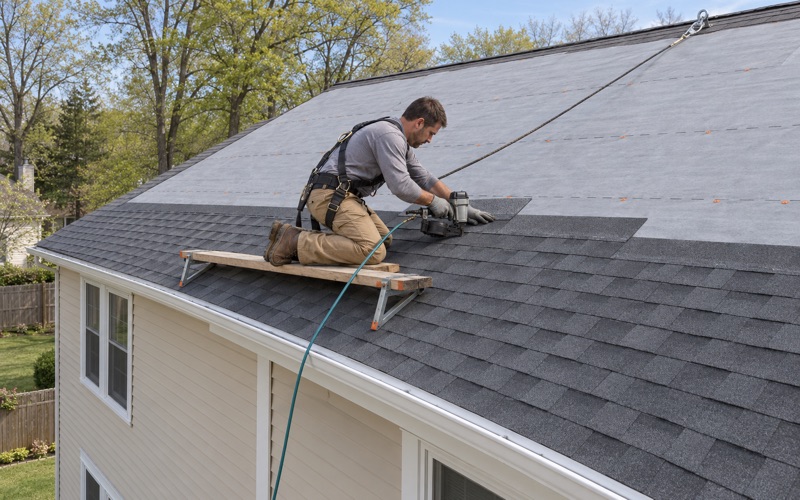
If decking turns out to be damaged once old material is off, we photograph it and show the owner before replacing it, at the per-sheet price written into the contract. Step, counter and chimney flashing is replaced along with any new roof rather than reused under it, and gutters are sized and pitched as part of the same job.
Photos for the owner’s claim
Storm damage is photographed and written up for the owner’s own insurance claim, with the roof edge, the soffit and any tree strikes each recorded. If the owner asks, a member of our crew meets the adjuster on site to walk the roof with them, but the claim stays the owner’s and we do not negotiate it.
Much of the damage near a path like this one turns out to be repair work, and we say so when it is. When a roof was already near the end of its life before the storm, we explain that difference plainly, so the owner knows which problems the storm caused and which were already there.
Clean-up on a property that already has debris
Storm repairs often happen on a lot that is still recovering from fallen limbs. At the end of each work day we clean the driveway, the yard and the gutters, and we run a magnet sweep for roofing nails. A family dealing with storm cleanup should not also be stepping around our leftovers.
- 20+ Years Experience
- Attic Checked on Every Leak
- Itemized Written Scopes