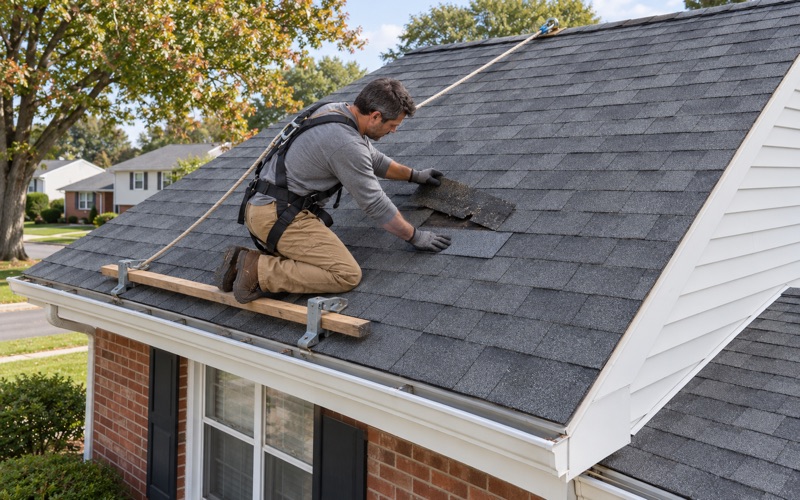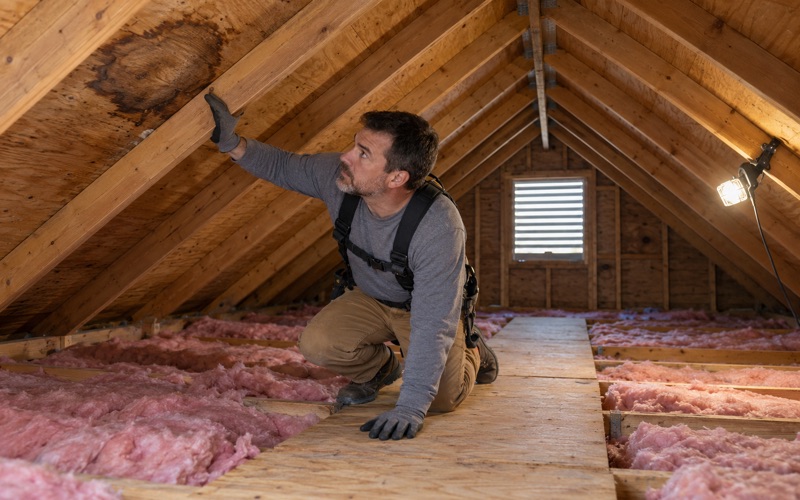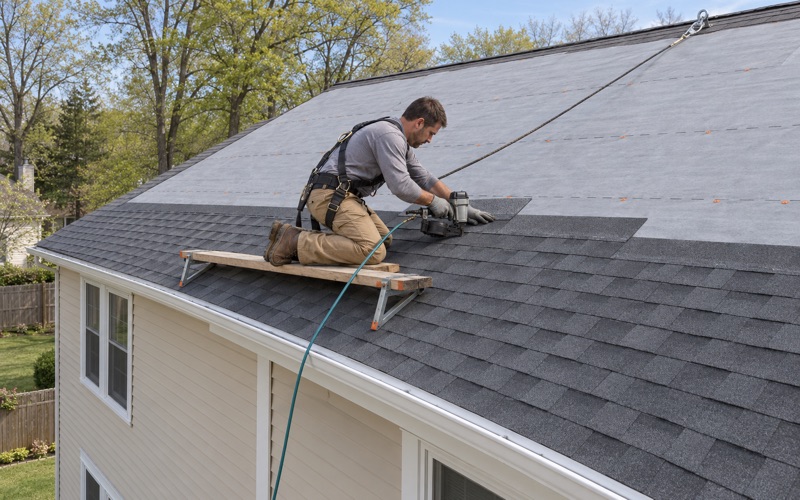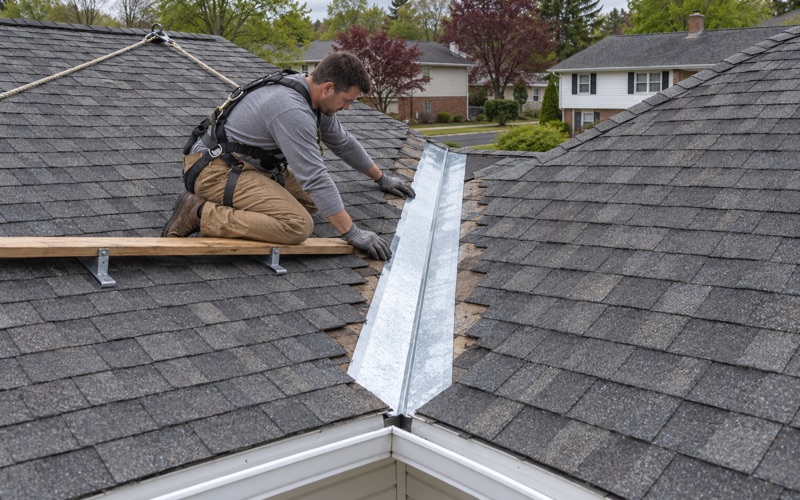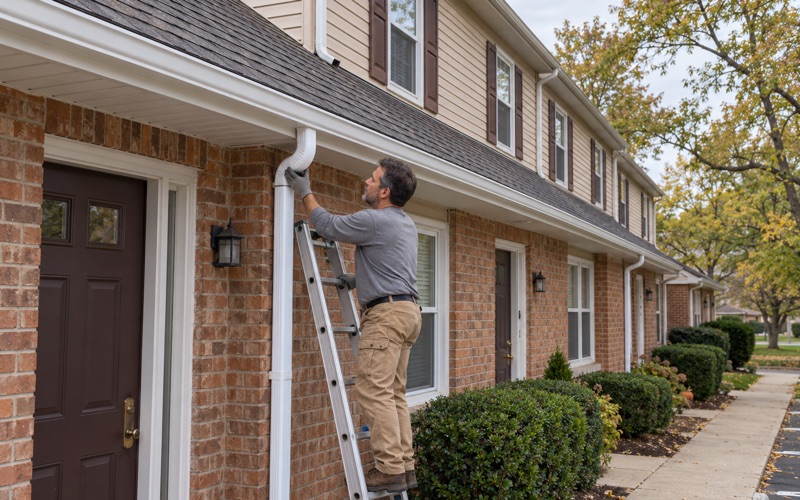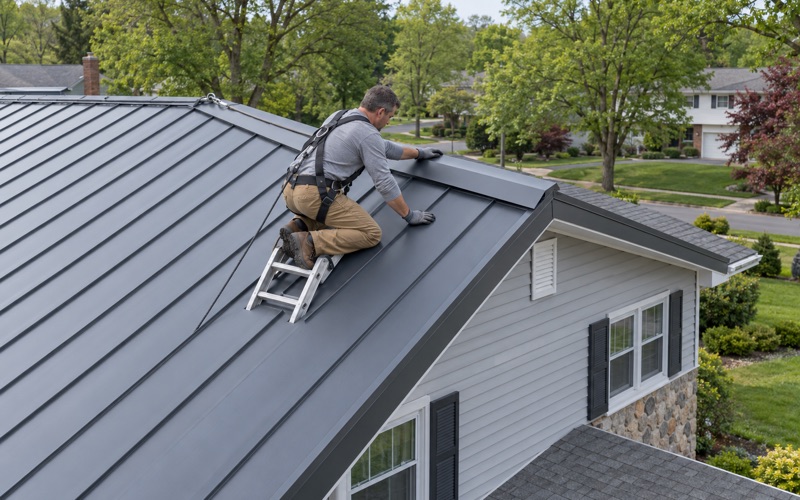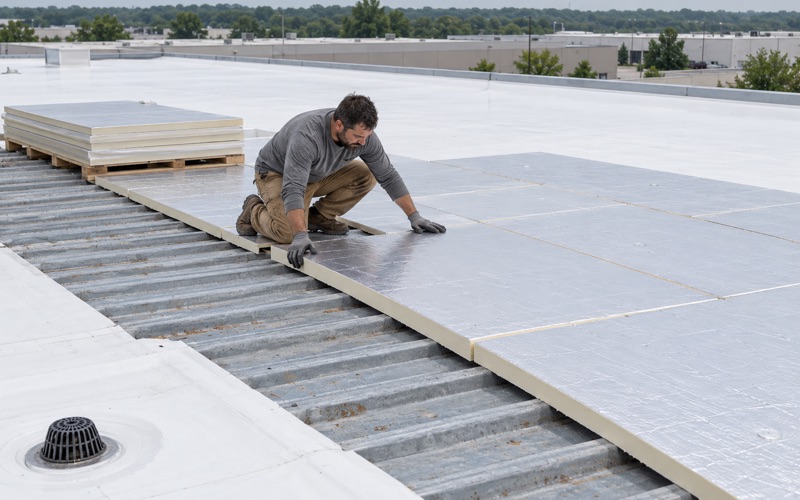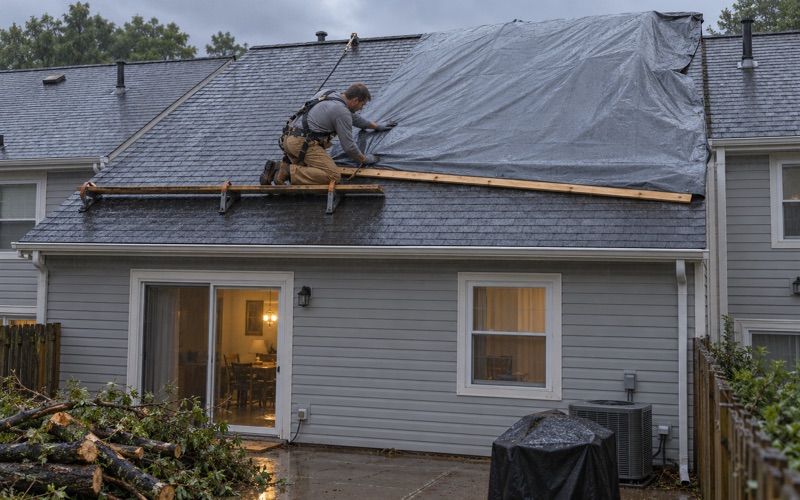
Bensalem Quality Roofing has handled roofing in Bristol for more than 20 years, and our work here starts the same way every time: at the eaves with a ladder and in the attic with a flashlight. When a ceiling stain appears, we follow the water back to the spot where it actually gets in before anyone talks about price, because a stain under a dormer can begin several feet uphill at a failed flashing seam.
The second thing we owe a homeowner is a plain verdict. If the roof can be repaired, we say so and price the repair; replacement comes up only when the shingles, the decking or the flashing have genuinely run out of life. Where a new roof is the answer, the estimate breaks out tear-off, decking, underlayment, flashing, ventilation and gutters as separate lines, so a competing bid can be laid beside it and read item by item.
Our Bristol jobs are written to Pennsylvania rules, not New Jersey’s, even though Burlington sits just across the water. Contracts follow the state’s home improvement law, with the three-business-day cancellation notice printed in and the deposit kept inside the legal limit. At the end of each work day the driveway, yard and gutters are cleared, and a rolling magnet goes over the lawn for stray roofing nails.
Bristol on the Delaware: Canal, Mills and Shipyards
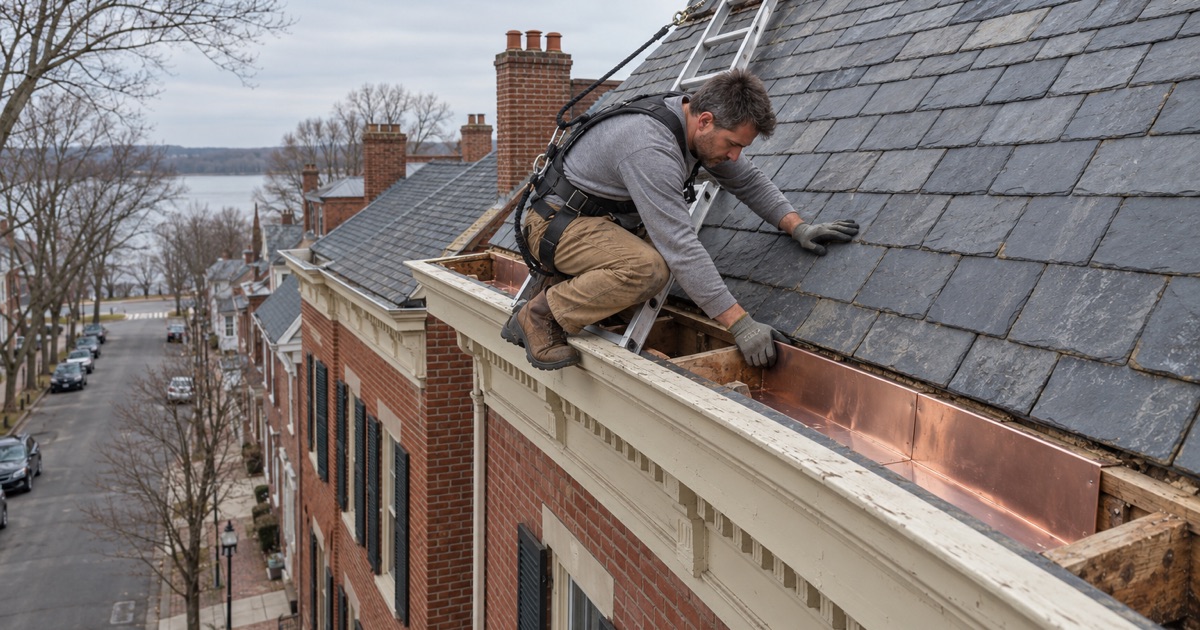
Bristol is a borough in Bucks County, set on the Delaware River opposite Burlington, New Jersey, about 23 miles northeast of Center City Philadelphia. It was the terminus of the Delaware Canal, and from its earliest days it was a center of textile mills; the Grundy Mill Complex is a former textile mill in town. Averell Harriman organized the borough’s shipyards during 1917, and many historic and restored houses line Radcliffe and Mill Streets.
Bristol Borough Is Not Bristol Township
Before we price anything, we confirm which municipality the house sits in. Bristol Borough covers about 1.9 square miles along the river, while Bristol Township is a separate municipality surrounding it on the land side, with its own offices and its own rules. A Bristol mailing address does not settle that question on its own.
Every township and borough in our service area sets its own re-roof permit rule, so the rule we check is the one for the house’s own municipality, never a neighbor’s. That check happens before the estimate is written, because a permit, its review time and its fee all belong in the price and the schedule from the start rather than as a change order later.
What a River Borough Means for the Roof
A town laid out along a working river puts its oldest houses closest to the water. That matters to a roofer because the roof and the lower floors of the same house can face two different kinds of water: rain and wind from above, and the Delaware itself at the river end of the block. We plan the roof knowing the rest of the house may carry its own history.
None of that changes how shingles are nailed, but it changes what we look at. On the older riverfront blocks we pay close attention to the attic, the wall-to-roof joints and the gutters that carry water away from foundations, since a roof that sheds water into a downspout aimed at a cellar wall has only moved the problem a few feet.
Looking for roofing closer to Middletown Township? See Roofing in Middletown Township.
Radcliffe Street, Mill Street and the River’s Top Crests
The National Weather Service tracks this stretch of the Delaware with gauge BDRN4, the Delaware River at Burlington, and that gauge carries a specific note for this town. At 9.9 feet, the stated impact reads that flooding begins around Radcliffe Street and Mill Street in Bristol. Minor flood stage on the gauge is 9.3 feet, moderate is 10.3 and major is 11.3.
The Crests That Set the Record
The highest crest on the Burlington gauge is 11.99 feet, reached on January 10, 2024, a figure the weather service still lists as preliminary. Before that, the river reached 11.94 feet on September 1, 2021, during Post-Tropical Cyclone Ida, and the same 11.94 feet on April 17, 2011. Sandy brought it to 11.69 feet on October 30, 2012.
Every one of those crests sits well above the 9.9-foot mark where the gauge says Radcliffe Street and Mill Street begin to see water. Our research turned up no tally of damage from any of them, and we will not invent one, but the numbers explain why owners near the river end of these streets think about water coming from more than one direction.
What a Crest Does and Does Not Mean Up Top
River water rises from below, so a crest is not a roofing event by itself. The storm systems that push the river up can also bring wind-driven rain, and that is when a lifted shingle, a cracked pipe boot or a loose ridge cap tends to show itself. After a big river week, we check the roof for those wind-side failures separately from anything happening at street level.
Storm Write-Ups for the Owner’s Own Claim
When a storm does lift shingles or open a flashing seam, we photograph the damage and write it up for the homeowner’s own insurance claim. If the owner asks, we will meet the adjuster at the house and walk the roof together, but we do not negotiate the claim. That role belongs to the owner, or to a public adjuster working under Pennsylvania’s Public Adjuster Licensing Law.
Large Repairs and the 50 Percent Question
If a house ever takes river water and the combined repair bill grows large, it is worth asking the borough early whether the FEMA substantial damage and substantial improvement 50 percent rule comes into play before the roof is replaced. We do not make flood determinations, but we would rather a homeowner hear that question from us before a contract is signed than afterward.
Old Roofs in a River Town: Bristol’s Pre-1940 Houses
Bristol’s housing is old by any measure. The American Community Survey counts 4,175 homes in the borough, and 2,163 of them, or 51.8%, were built in 1939 or earlier. Another 406 date from the 1940s and 581 from the 1950s, so most of the roofs we look at here sit on framing that has carried weight for generations.
The mix of houses matters as well. Nearly half the borough’s homes, 1,974 or 47.3%, are one-unit attached houses, and owners occupy 2,451 of the 4,018 occupied homes. On an attached house, our plan accounts for the neighbor’s roof and the shared wall from the first visit, so the joint between the two roofs is flashed as one job rather than left as a seam.
Decking Under an Old Roof
On a house this old, nobody knows exactly what is under the shingles until the tear-off. Board sheathing, earlier roof layers and patched sections are all possible, and some of it may no longer hold a nail. When we find damaged decking, we photograph it and show the owner before any of it is replaced, at the per-sheet price already written into the contract.
Layer count matters too. The 2021 International Residential Code as adopted in Pennsylvania governs reroofing through IRC R908, including its two-layer limit, so a house that already carries two roofs gets a full tear-off rather than a third layer laid over the top. That decision is made at the estimate, not discovered on the day the crew arrives.
Flashing on Chimneys and Old Walls
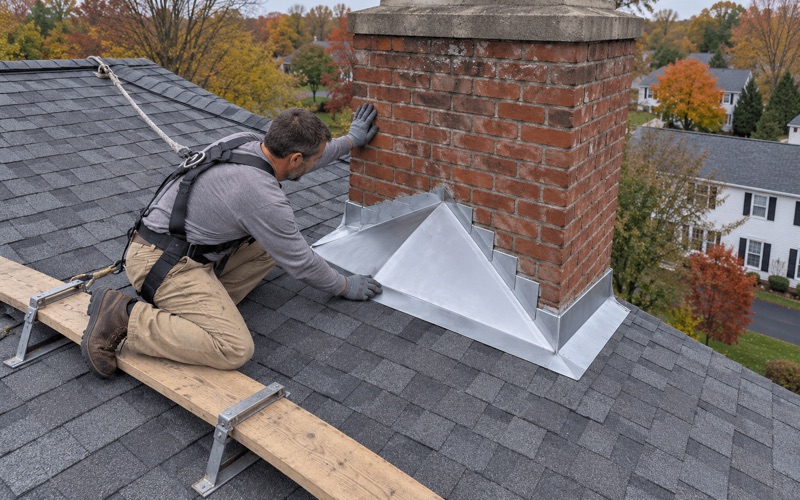
Older Bristol houses tend to carry masonry chimneys and roof-to-wall joints that have been sealed and resealed many times. We replace step, counter and chimney flashing with the roof instead of reusing it under new shingles, set counter flashing into a reglet where the masonry allows, and add a chimney cricket behind a wide chimney so water is turned aside rather than pooling.
At the eaves, drip edge and a self-adhering ice and water barrier meeting ASTM D1970 go down under the shingles, following the IRC R905.1.2 ice barrier provision. Kick-out flashing at the base of each wall-to-roof line keeps runoff out of the siding behind the gutter end, a spot where older houses often hide years of slow rot.
Painted Trim on Pre-1978 Homes
Every house built before 1940 is also a house built before 1978, which brings in the EPA RRP lead-safe rule whenever painted fascia, soffit or trim is disturbed. On these jobs we plan containment around the eaves and the cleanup that goes with it, and the end-of-day magnet sweep happens alongside the lead-safe cleanup rather than in place of it.
Gutters and Ventilation for an Older Attic
Old attics were rarely built with balanced ventilation in mind. Where the framing allows, we pair a ridge vent with soffit intake sized by net free area, so heat and moisture leave the attic instead of working on the decking from underneath. Seamless aluminum gutters and downspouts are sized and pitched with the roof, so the water ends up well away from the house.
Bristol Borough’s Building Permit for Roofing
Bristol Borough’s Building Permit Guidelines list roofing among the work that needs a building permit, alongside additions, siding and windows that are not replacements. The same guidelines say permit approval must be obtained before work begins, and that permits are normally reviewed and approved within two to five working days. We fold that review time into the schedule from the first estimate.
Where the Permit Comes From
The borough’s inspection office is at 250 Pond Street, an address the Census Geocoder places inside Bristol borough rather than the township around it. The borough’s fee schedule adds the state building permit fee of $4.50 to its own charges. We handle the application as part of the job and show the permit as its own line on the contract.
Because the rule is the borough’s own, we do not carry it over from another municipality or assume it matches the township next door. The Pennsylvania Uniform Construction Code sets the state framework, but each municipality’s treatment of re-roofing is what decides the paperwork for a particular house, and that is the rule we read before pricing.
The Bristol Historic District
The Bristol Historic District, listed on the National Register on April 30, 1987, covers 28 acres and over 300 buildings on the original 1697 town site, bounded by Pond, Cedar and East Lincoln Streets, the Delaware River and East Mill Street. We found no borough review board or certificate process for exterior work there, and National Register listing on its own does not create one.
For a house inside the district, then, the paperwork we found is the same building permit as anywhere else in the borough. What changes is the care: on a house that has stood for a century or more, we choose a roof that suits the building it sits on and keep original trim intact wherever it can stay.
Contracts Written to Pennsylvania Law
Bristol jobs are Pennsylvania jobs, even with the Burlington-Bristol Bridge in view. Our contracts follow the Home Improvement Consumer Protection Act, with the three-business-day right of rescission printed in and the deposit held within the one-third cap on contracts over $5,000. Sales tax on materials follows Pennsylvania’s rules for construction materials, not New Jersey’s capital improvement certificate.
- 20+ Years Experience
- Attic Checked on Every Leak
- Itemized Written Scopes